
Regulatory Framework and Hazard Identification
OSHA 1910.133 and Propane Handling Rules
OSHA 1910.133 sets the baseline for eye and face protection, a component of what ppe is required when dispensing propane. The regulation requires workers to wear gear whenever hazards like flying debris or chemical splashes exist. Propane dispensation falls within this mandate because liquid vaporization can cause freezing burns to the eyes and skin.
Beyond federal standards, propane handling rules from industry bodies add another layer of protection. Consider the physical risks first. The liquid boils at minus 42 degrees Celsius, and contact with uninsulated skin produces frostbite. Vapor leaks create invisible hazards that displace oxygen in confined spaces, making respiratory protection essential alongside standard gloves and goggles.
- Inspect hoses and valves before each dispensation.
- Verify the fill nozzle seals completely.
South African operators must align these international standards with local regulations from the Department of Labour to maintain compliance across both frameworks.
NFPA 58: Safe Transfer and Storage Codes
The regulatory framework for bulk propane storage in South Africa often references NFPA 58, which provides the code for safe transfer and storage. This code impacts what ppe is required when dispensing propane, as it dictates the design of the transfer area and emergency shutdown protocols. Prior to any transfer, a hazard identification sweep is essential.
Conduct a visual survey for vapor clouds or leaks, and confirm the functionality of the emergency stop valve. Operators must understand that the hazard is not always visible. NFPA 58 also specifies the storage location and tank maintenance that reduces risk before the PPE is even donned. Consistent with the Department of Labour mandates, this proactive identification prevents the circumstances where inadequate protection becomes a liability. The standard demands that workers verify all equipment before connecting the line, ensuring that the safety system functions as a single, unified barrier.
Identifying Primary Exposure Vectors (Liquid, Vapor, Container)
South African regulations require a hazard identification sweep before any transfer begins. This sweep answers what ppe is required when dispensing propane only after the immediate threats are mapped. A visual survey for vapor clouds, a check of the emergency stop, and a hand test on the hose all precede the moment of connection.
The primary exposure vectors define the danger:
- Liquid propane causes frostbite and boils off quickly.
- Vapor spreads low and can suffocate or ignite.
- Container failure means a sudden release under pressure.
Each vector changes the operator’s priority. Liquid demands insulated gloves. Vapor demands respiratory awareness. Container failure demands distance and secure mounting. The regulatory framework forces this thinking before any PPE decision is ever made.
Performing a Risk Assessment Before Dispensing
Every year, propane dispensers lose fingers not to flame, but to the cold shock of a leak. The South African regulatory framework mandates a documented risk assessment before any transfer begins. The HIRA process is a strict requirement, forcing the operator to record the pressure, the line, and the ambient air before the coupling turns.
A pressure differential hisses. A seal cracks. The answer to what ppe is required when dispensing propane arises only after this audit. The assessment pinpoints task-specific hazards, from static charge in dry wind to worn threads on a fitting.
- Define the task boundaries, tracing the flow from tank to nozzle.
- Evaluate environmental conditions, noting wind, shade, and ignition sources.
- Determine control measures, specifying exact garments and eye shields.
Only then does the operator know what ppe is required when dispensing propane, donning cold-resistant gloves and a face shield. The regulation is a direct order, not a formality.
Eye and Face Protection Essentials
Safety Goggles vs. Face Shields for Splash Protection
When the vessel breathes its chilling vapor, the eyes become the first casualty. Safety goggles form a sealed barrier against liquid propane splashes, while face shields guard the broader visage but leave gaps below. For those pondering what PPE is required when dispensing propane, the eye and face decision hinges on hazard geometry.
A splash of liquefied gas demands goggles that clasp the eye socket with unyielding fidelity. Face shields alone permit ingress from beneath, a silent betrayal. I have seen operators rely on a single shield, only to feel the searing cold creep under the chin. Consider the task at hand:
- If the transfer line may weep or burst, goggles are the baseline.
- If the nozzle could whip upward, a shield over goggles offers layered defense.
Neither replaces the other entirely. Each serves a distinct threat, so the correct choice emerges from reading the specific hazard before you. That is the true answer to what PPE is required when dispensing propane in this context.
Impact-Resistant Lenses and Anti-Fog Properties
When dispensing propane, the threat of cryogenic burns and high-pressure spray dictates a rigorous eye and face protection strategy. While a full-face shield offers broad coverage against unexpected splashes, it is inadequate as a standalone defense. The critical component is a pair of impact-resistant safety goggles worn beneath the shield. These goggles must be constructed from polycarbonate to withstand the potential shatter force of a hose rupture, sealing tightly around the eyes to block out vapor that condenses rapidly.
Fogging is a persistent enemy in this environment, as temperature differences cause lenses to mist over, severely impairing vision during a critical transfer. Anti-fog coatings are not a luxury but a functional necessity, allowing operators to maintain a clear sightline when moving between the tank and the delivery point. Proper ventilation channels in the goggle frame further reduce moisture buildup without compromising the seal.
To answer what PPE is required when dispensing propane at the point of transfer, one must consider the layered approach. The primary answer for the face involves this protective pairing. Beneath that, insulated gloves and flame-resistant clothing complete the ensemble, but the eyes remain the most vulnerable. A face shield alone leaves the orbital area exposed; goggles alone leave the rest of the face vulnerable to liquid strikes. For most industrial tasks, the combination of both, with anti-fog and impact-resistant lenses as the baseline, ensures the operator is equipped to handle the pressure of the task without sacrificing visibility.
Emergency Eye Wash Accessibility
Picture this: an operator catches a rogue spray on the visor, rips the rig off, and then jogs across the yard to reach an eyewash station buried behind a stack of stock. The comedy ends when you consider the alternative. Corneal damage is not a punchline. Trust me, you do not want to be counting seconds while your eye is burning.
Emergency eye wash accessibility is not a footnote to what PPE is required when dispensing propane. It is the contingency that makes the whole ensemble credible. The station must sit within ten seconds of the transfer point, roughly fifteen meters. It must deliver tepid water at low pressure, not a firehose. And it needs weekly testing, because dormant nozzles corrode quietly.
- Plumbed stations need a weekly activation check.
- Self-contained units require a stricter maintenance schedule.
If the unit is out of reach, out of order, or buried behind stock, you own an expensive decoration.
Hand and Skin Protection Measures
Cryogenic Gloves for Sub-Zero Temperature Contact
Liquid propane sits at a brutally cold -42°C. That isn’t just a number; it is the threshold for severe frostbite upon direct skin contact. When you are handling the transfer hose, the risk of a spill or a spray is ever-present. Protecting your hands and arms is non-negotiable, and standard work gloves simply won’t cut it out in the field. You need gear designed for sub-zero contact.
The right hand protection starts with insulated, waterproof gloves. Look for styles with a leather outer shell and a thermal lining, often rated specifically for cryogenic work. These gloves must fit snugly at the wrist to prevent any liquid from running down your arm. Additionally, wearing a long-sleeved, padded jacket or a dedicated APR (apron) creates a barrier against splash. This layered approach is your primary defence against the immediate burn of evaporating propane.
To ensure you have the correct level of protection, your selection should cover the following essentials:
– Insulated gloves with a waterproof coating to repel liquid propane.
– Gauntlet-style cuffs that extend over the jacket sleeve for a secure seal.
– A heavy-duty, chemical-resistant apron to shield the torso and upper legs.
Ultimately, knowing what ppe is required when dispensing propane means respecting the physical properties of the liquid. Your hands are your most vital tools. If they are exposed to the cold for even a few seconds, the damage can be permanent. So, make the investment in proper cryogenic gloves and sleeve protection. It is a small price to pay for keeping your digits safe and functional.
Chemical-Resistant Materials (Nitrile, Neoprene)
In the propane dispensing workflow, the skin’s integrity depends on more than warmth. The liquid’s ability to seep through ordinary fabrics turns a minor splash into a medical emergency. Chemical resistant PPE, specifically nitrile and neoprene, forms the barrier between your dermis and a substance that evaporates at -42°C. These materials do not merely repel moisture. They resist permeation, the process where chemicals migrate through the glove at a molecular level.
Nitrile offers superior puncture resistance and holds up well against petroleum derivatives. Neoprene provides flexibility and stands firm against both cold and chemical attack. For tasks like connecting the transfer hose or bleeding the line, these gloves deliver dexterity without sacrificing protection. A glove that cracks in low temperatures creates a false sense of safety.
Consider the following when selecting chemical resistant hand protection:
- Check the glove’s breakthrough time against propane or LPG.
- Inspect for swelling or hardening after each use.
- Replace gloves that show signs of degradation.
Layered with a chemical resistant apron, nitrile or neoprene gloves reduce skin contact during routine dispensing. Remember that what ppe is required when dispensing propane depends on the specific task. A splash hazard during coupling demands different coverage than a slow leak during valve maintenance. South African operators face harsh sun, but the cold and chemical exposure remains the real threat. Prioritise materials that fail loudly, not silently.
Long-Sleeved Shirts and Protective Aprons
Dispensing propane is a routine task that carries a hidden weight. The liquid inside that steel cylinder sits at a staggering -42°C, and the moment it hits the atmosphere, it transforms into a vapour that can displace the very air you breathe. The question of what PPE is required when dispensing propane becomes less about compliance and more about confronting the physics of the substance you are handling. In the South African context, whether you are filling forklift tanks at a depot in Johannesburg or managing a rural gas distribution point, the cold and the pressure demand a specific set of defences.
The primary threat is always the liquid state. If a hose ruptures or a coupling fails, the spray will freeze anything it touches instantly. This is where your choice of gloves is critical. Standard cotton or leather work gloves are a hazard here; they absorb the liquid and hold it against the skin, accelerating frostbite. You need a barrier that rejects moisture and resists the低温. For the high-risk actions of connecting the transfer hose or bleeding the line, neoprene gloves are the superior option. They provide the necessary flexibility to grip wet fittings while creating a waterproof seal. While nitrile gloves are excellent against petroleum derivatives and offer superior puncture resistance against sharp valve edges, neoprene tends to offer better insulation against the cold transfer that occurs through the metal. You must also inspect the gloves for swelling or hardening after each shift, as repeated exposure to the liquid will degrade these materials.
Your eyes are just as vulnerable as your hands. A splash of liquid propane into the eye will cause corneal damage before you can even blink. When selecting face protection, the specific task dictates the gear. For simple valve operation, a pair of impact-resistant goggles with anti-fog properties is essential; the anti-fog coating is not a luxury, it is a safety feature, as the cold vapour will instantly cloud a cheap visor, blinding you at the critical moment. However, for tasks involving breaking a seal or disconnecting a line, a full-face shield worn over the goggles is the only acceptable level of defence. It protects your throat and neck from a spray that would otherwise run down your face and freeze.
Beyond the immediate flash risk, the colder elements of the environment play a role. The metal of the cylinder and the transfer hose become conduits for the cold. If you are working in a winter morning in the Free State, the risk is doubled. This brings the final layer of protection into focus.
– Wear a long-sleeved shirt and a protective apron made from a heavy, coated fabric to shield your torso from spray and splashes.
– Tuck gloves over the sleeves of the apron, never under them, to create a continuous seal that prevents liquid from running down your arm.
– Ensure the apron covers your thighs, as a spray directed downwards can pool in your lap.
The reality of handling this fuel is that human instinct is a poor judge of its lethality. The skin initially feels cold, then numb, and by the time pain registers, the damage is done. Understanding what PPE is required when dispensing propane is not simply a checklist item; it is the line between a routine operation and a medical emergency. The gear protects you from the silent, invisible transition the liquid makes as it greedily absorbs heat from your flesh. It is the difference between a day on the job and a life-altering injury.
Managing Frostbite and Thermal Burns
The cold burns before it numbs. That is the deception of liquid propane. When skin meets the spray, ice crystals form inside the tissue almost instantly. Rewarming becomes the priority, but only after removing contaminated clothing safely.
Ask what ppe is required when dispensing propane and the answer starts at the fingertips. Gloves alone are not enough. The seal between glove and sleeve matters just as much. A gap at the wrist is where liquid finds its way inside, pooling against bare skin without immediate sensation.
- Never rub frostbitten skin. Friction worsens cell damage.
- Immerse in lukewarm water near 37°C. Hot water accelerates tissue death.
- Remove rings and watches immediately. Swelling begins within minutes.
Thermal burns from cold exposure look pale and waxy before they turn red. Pain arrives late. Medical evaluation is mandatory, not optional.
Proper Glove Thickness and Glove Deterioration
Asking what ppe is required when dispensing propane forces attention to glove thickness. Standard work gloves fail because liquid propane finds microscopic gaps. Cryogenic-rated gloves measure thickness in mils, often 20 to 40, but thicker is not always safer. Excess material reduces dexterity and increases tear risk at the palm creases.
Glove deterioration follows a quiet path. Ozone cracking appears along the flex points, and repeated contact with propane accelerates hardening. Inspect before every shift. Squeeze the glove. If it resists compression or shows white stress marks, discard it!
- Check seams for pinhole leaks
- Test elasticity after cold storage
- Replace after any splash contact
The seal between glove and sleeve remains the true barrier. A torn cuff or a worn wrist closure invites liquid inside. That answer to what ppe is required when dispensing propane never ends at a single purchasing decision.
Respiratory Protection and Air Monitoring
Monitoring Oxygen Levels and LEL (Lower Explosive Limit)
The Essential PPE for Propane Dispensing: A Guide to Staying Safe on the Job
The quiet hiss of gas moving through a hose is a sound that many industrial workers hear daily. It is a routine sound, but one that carries an immense responsibility. Dispensing propane is a high-stakes task where a simple mistake in equipment or a lapse in personal protection can lead to catastrophic consequences. Understanding what PPE is required when dispensing propane is not just about ticking a compliance box; it is about ensuring you return home safely at the end of your shift.
We often focus on the fire risk, which is valid, but the immediate physical danger is equally severe. Propane is stored as a liquid under high pressure. When released, it rapidly expands into a gas and drops to an incredibly low temperature. Skin contact with this cold jet stream can cause instant, severe frostbite, similar to a thermal burn. Additionally, the heavy vapor can displace oxygen in low-lying areas, creating an asphyxiation hazard that is invisible and odorless until additives are introduced.
Assessing the Core Hazards
Before suiting up, it is necessary to understand the environment you are entering. The primary vectors of risk fall into three distinct categories: the liquid phase, the vapor phase, and the equipment itself.
1. The Liquid Phase: This is the most dangerous for the skin. Direct contact with liquid propane or the cold metal of the transfer hose can cause immediate tissue damage.
2. The Vapor Phase: As the liquid boils off, it creates a flammable vapor cloud. While the vapor is not necessarily cold at distance, it is highly combustible and can displace oxygen.
3. The Equipment: The transfer couplings, valves, and hoses are under extreme pressure. They can fail violently, sending shrapnel or a high-pressure jet of liquid and gas toward the operator.
Given these risks, the answer to what PPE is required when dispensing propane involves a multi-layered defense. It is a system of protection, not just a single item.
The Cold Barrier: Protecting the Hands and Arms
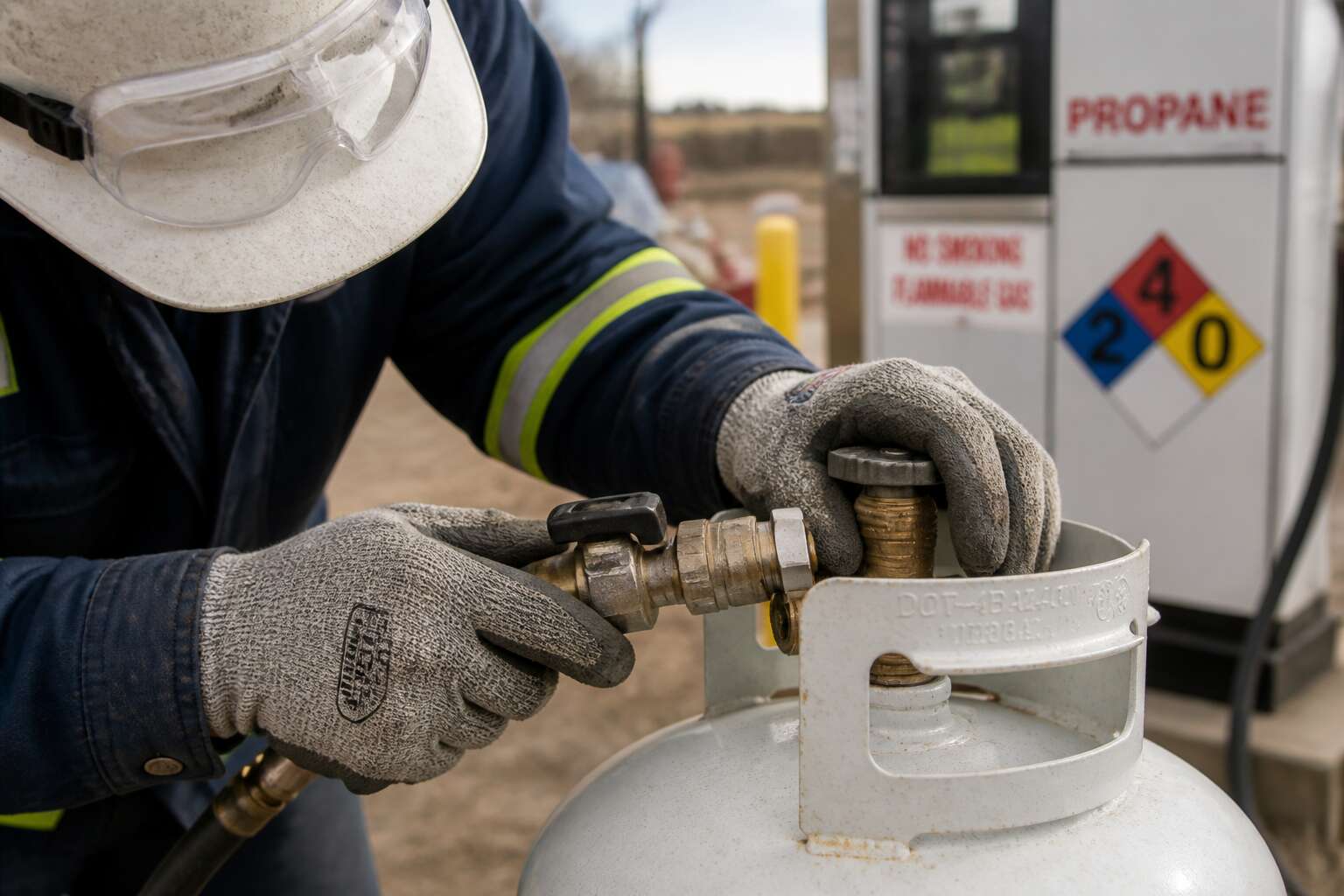
The first line of defense is your gloves. Standard leather work gloves are useless here; they will freeze and become brittle. You need heavy-duty, insulated gloves that are specifically rated for cryogenic or low-temperature applications. These gloves are typically made with a waterproof outer shell and a thick insulating lining that slows the transfer of cold.
The length of the glove matters as much as the material. If you are connecting a hose, liquid can splash or spray. You need gauntlet-style gloves that extend well past your wrist, ideally reaching up towards the elbow. This design ensures that there is no gap between your glove and your sleeve where a splash could land. The hand is the most exposed part of the body, and the gloves are your absolute non-negotiable protection against frostbite.
Shielding the Body and Eyes
Moving up the body, the torso requires protection against splashes and flash fires. A fire-resistant (FR) coverall or jacket is recommended. While it must be FR, it also needs to provide a barrier against the cold liquid. Some operators prefer a full chemical splash suit over their base layers, especially in high-flow scenarios. The suit should cover all exposed skin, preventing any accidental spray from hitting your arms or legs.
Your eyes are incredibly vulnerable. A simple pair of safety glasses will not suffice for a high-pressure transfer. You need a full face shield. This shield should be worn over your primary safety glasses to offer dual protection. The face shield acts as a barrier against a direct spray to the face, while the safety glasses protect against any splashes that might get behind the shield. This is a critical part of what PPE is required when dispensing propane, as facial injuries are often the most severe and life-changing.
Respiratory and Monitoring Equipment
This is where many novice operators make a critical error. They assume that because propane has a strong odor, they will smell a leak. This is dangerous complacency. In a large release, the gas can quickly displace the oxygen in your breathing zone, and you can lose consciousness before you even register the smell.
At a minimum, you must have a calibrated portable gas detector clipped to your collar. This device constantly monitors the air for explosive levels (LEL) and oxygen deficiency. It is your electronic nose that alerts you to danger before it is too late. However, the detector is a warning device, not a respiratory protector. If you are working in a confined space or handling a potential large leak, you need to wear a self-contained breathing apparatus (SCBA) or a supplied air respirator. Large, industrial-scale dispensing often requires a full airline respirator to ensure the air you are breathing is completely isolated from the ambient environment.
When the Elements Turn Hostile: The LEL Monitor
Understanding the numbers is part of safety. The Lower Explosive Limit (LEL) for propane is approximately 2.1% by volume in air. Below this, the mixture is too lean to ignite. Above this, it is too rich to ignite. The danger zone is in between. Your gas monitor is your primary tool here.
However, you cannot rely on the monitor alone. The monitor is the sensor; you are the response system. When the monitor alarms, you must stop the transfer immediately and shut off the supply. This is why it is essential to have emergency shut-off controls within easy reach. The LEL monitor reading is not a suggestion; it is a command to cease operations and ventilate the area. The interaction between your senses, your PPE, and the digital readout of the monitor is what prevents a routine refill from turning into a fireball.
Practical Application and the Element of Time
The final, often overlooked component of the PPE ensemble is time management. No glove or suit is impervious to the cold indefinitely. Cryogenic gloves have a finite “contact time” rating. If you are continuously handling a cold coupling for an extended period, the cold will eventually penetrate the insulation.
When dispensing, you should work in a controlled, deliberate manner. Connect the couplings quickly, but without rushing. Once the transfer is complete and the lines are disconnected, remove your gloves and allow them to warm up fully before the next use. If you are doing multiple fills back-to-back, rotate your gloves to prevent residual cold from building up. This attention to detail is what separates a professional from an amateur. The PPE is your shield, but your understanding of its limits is your true defense.
Air-Purifying Respirators vs. Supplied-Air Systems
Air-purifying respirators use cartridges to filter contaminants. Propane dispensing complicates that approach. Propane is a gas, not a particulate. It displaces oxygen. A cartridge cannot create oxygen. If oxygen drops below 19.5 percent, an air-purifying respirator fails completely. I have watched operators trust these filters in oxygen-deficient zones. That trust can kill.
Supplied-air systems deliver breathing air from a safe source. This is what ppe is required when dispensing propane in high-risk scenarios. An SCBA carries a finite air supply. An airline respirator connects to a remote source. Both keep you breathing when the surrounding air becomes dangerous.
Consider the practical difference:
– Air-purifying: filters particles, fails on oxygen displacement
– Supplied-air: independent of the surrounding atmosphere
– SCBA: portable, limited duration
– Airline: unlimited duration, tethered to a hose
The scenario dictates the choice. Open-air transfers with good ventilation allow monitors and standard precautions. Confined spaces demand supplied air. No filter cartridge removes the risk of asphyxiation.
Fit Testing Requirements and Seal Check Procedures
Your respirator is a failure waiting to happen if you skip the fit test. In South Africa, the law does not care how confident you feel. Fit testing, whether quantitative or qualitative, must happen before first use and every year after. This is a nonnegotiable piece of what ppe is required when dispensing propane. Air monitors give you the warning. A sealed respirator gives you the escape.
- Remove the cartridge to expose the inlet, then inhale briefly.
- The mask should suck against your face, proving no air leaks inwards.
- Exhale sharply to see if air escapes around the edges.
- Adjust straps and repeat until the seal holds.
That ritual takes fifteen seconds. Skipping it takes one emergency to kill you. Fit tests are the paperwork. Seal checks are the daily proof. Do not mix them up.
Recognizing Symptoms of Propane Overexposure
Your nose is a terrible gas detector. Propane overexposure announces itself through nausea, dizziness, and a creeping headache that feels like pressure behind the eyes. By the time you smell the odorant, your central nervous system may already be swimming. I have watched operators swear the air was fine while their oxygen saturation dropped. That is why air monitoring is not a courtesy. It is your only warning.
The symptoms are insidious. Euphoria, then confusion. Slurred speech, then collapse. In a confined space, you do not get a second chance.
Recognise the signs early:
- Sudden fatigue
- Nausea or vomiting
- Blurred vision
- Rapid heartbeat
Respirators filter. Air monitors detect. Neither replaces the other. When you are calculating what ppe is required when dispensing propane, put the alarm on the list before the gloves. The cheapest PPE is a functioning sensor and the discipline to evacuate when it screams.
Footwear, Clothing, and Additional Gear
Steel-Toe Boots with Non-Slip Soles
Stepping onto a propane fill station floor demands more than just a checklist. Your footwear is the first line of defense, and it needs to be steel-toe boots with non-slip soles. These are not optional upgrades; they are the foundation of your safety. The unforgiving concrete and the weight of heavy tanks create hazards that only proper boots can mitigate. A dropped cylinder can fracture a foot in an instant, turning a routine task into a career-ending injury. The slip-resistant outsole is equally critical, providing the grip you need when dealing with moisture or accidental spills, which are common in this line of work.
Beyond the boots, your clothing acts as a shield against the brutal cold of liquid propane. You need fire-resistant coveralls or long-sleeved shirts tucked in, paired with heavy-duty work pants. These garments protect your skin from frostbite during any accidental exposure. Combined with the insulated, chemical-resistant gloves and a face shield you already have from our previous discussion, this ensemble ensures you are fully armored. When you ask what ppe is required when dispensing propane, the answer is a complete system. The right protective gear turns a high-risk job into a controlled procedure, allowing you to focus on precision instead of worrying about your personal safety.
Flame-Resistant Coveralls for Spark Hazards
For dispensing propane, my footwear goes beyond a basic boot. I choose a pair with reinforced toe caps and a midsole plate that stops punctures. The design should lace above the ankle to keep the foot locked in place.
Clothing must be buttoned and secured. Avoid open necklines and rolled sleeves. Choose heavy cotton weaves, and keep everything tucked in so the skin never sees direct spray.
Flame resistant coveralls are the additional gear that handles spark hazards. They repel ignition and reduce burn injuries. If you are asking what ppe is required when dispensing propane, factor in these coveralls. Do not forget the correct gloves and eye protection!
Optional Hearing Protection for Pressure Relief Valves
Footwear anchors the body against slips while resisting hydrocarbon absorption. I choose static dissipative boots with sealed seams and a composite toe. The midsole guards against punctures from valve stems or dropped fittings. Lace fully and tuck laces inside so they never catch on hoses.
Clothing requires the same discipline. Every button and zip stays closed! The shirt collar sits up, not folded down, to shield the neck from stray vapour. Cuffs are fastened tight around the wrists. I avoid pockets with open flaps because they collect propane liquid during a spill.
Optional hearing protection matters when pressure relief valves chatter. That sudden hiss can register above 110 decibels. The options are simple:
- Foam earplugs with a 25 NRR or higher
- Earmuffs that seal fully around the ear
For operators asking what ppe is required when dispensing propane, the answer includes footwear, disciplined clothing, and awareness of noise exposure.
PPE Maintenance, Training, and Emergency Protocols
Pre-PPE Inspection Checklist for Cracks and Wear
Safety equipment has a finite lifespan, and neglect turns protection into a liability. A pre-use inspection for cracks, tears, or brittle spots takes only minutes but can prevent a catastrophic failure. Check every seam and strap on your gloves and coveralls before each shift. Store gear away from direct sunlight and moisture, as UV rays and humidity accelerate material degradation. Clean your face shield with mild soap and warm water, never solvents that cloud the lens. Replace any component that shows signs of wear; a compromised seal on your respirator is a direct invitation for vapor exposure.
Training should go beyond a simple orientation. Workers need to understand why what ppe is required when dispensing propane, not just what to wear. This deeper understanding drives compliance when fatigue sets in at the end of a long day. Emergency protocols for frostbite or cold burns need to be drilled until response becomes muscle memory. Someone who knows where the eyewash station is located will still waste precious seconds if they have to think about it. Regular, hands-on sessions that simulate a valve failure or a liquid release build confidence. The quiet steadiness of a crew that has rehearsed for trouble is the most reassuring sound at a rural filling station; it is the sound of people who know their gear and trust their training.
Correct Donning and Doffing Order to Prevent Contamination
Correct donning and doffing order is the silent partner of proper maintenance. It is not enough to own the right gear. You must know the sequence that prevents cross contamination after every shift. Touch a clean respirator with a contaminated glove, and the entire seal of protection is broken.
The order matters. Put on your flame resistant coveralls first. Then your steel toed boots, followed by your respirator and face shield. Gloves go on last. This sequence ensures no bare skin contacts straps or seals that will sit against your face. When removing gear, reverse the order. Remove gloves first, then the face shield, then the respirator. Wash your hands immediately after. This practice keeps residue from one task away from the next, a key part of what ppe is required when dispensing propane.
Placement and Use of Emergency Showers and Eyewash Stations
The Right Armor for the Job: What PPE is Required When Dispensing Propane
The gas itself is odourless. The sharp, pungent smell you associate with a leak is actually an added warning agent, a silent alarm system. Even with that safeguard, an accidental release during a transfer can create a invisible cloud that pools near the floor, waiting for a single spark. Propane is heavier than air, and it displaces the oxygen you need to breathe. Suffocation and explosion are the two primary risks, and they dictate the standards for personal protective equipment.
To answer the question of what PPE is required when dispensing propane, you first have to accept that there is no single “one-size-fits-all” answer. The required gear shifts depending on whether you are performing a simple cylinder swap at a retail kiosk or conducting a bulk transfer from a road tanker into a fixed storage vessel. However, the non-negotiable baseline always starts with eye protection. Safety glasses with side shields are the minimum, but for a transfer operation, a full-face shield is significantly safer. It protects against a sudden burst of liquid that could flash to vapour and cause severe frostbite on the skin.
Your hands are the next frontier. Heavy-duty, insulated gloves are essential because liquid propane boils at approximately -42°C. A splash can freeze tissue instantly. Standard leather work gloves offer abrasion resistance but do little against the cold. You need gloves designed for cryogenic handling, often lined and with a waterproof outer layer. They must fit properly; a bulky glove reduces dexterity when securing a hose coupling, which is precisely when accidents happen.
—
Building a Layered Defence
Beyond the immediate contact hazards, the clothing you wear acts as a barrier. This is where an often-overlooked standard comes into play. Flame-resistant (FR) clothing is not an accessory; it is a primary requirement. In the unlikely event of a leak igniting, FR fabrics will not melt into your skin the way synthetic materials like polyester will. A cotton or FR-rated long-sleeve shirt and pants are a must. You should never wear shorts or loose-fitting clothing that could catch on valves or fittings.
For respiratory protection, the risk is oxygen deficiency rather than toxicity. A simple dust mask is useless. Depending on the ventilation and the size of the operation, you may need a supplied-air respirator, but for most standard dispensing tasks, a properly fitted, multi-gas monitor is the more critical companion. It detects oxygen levels and lower explosive limit (LEL) readings. The monitor tells you when to get out, not just what to wear.
Finally, consider the boots. High-top, steel-toed boots are the standard. The high top protects your ankles from a splash, and the steel toe guards against a heavy cylinder dropping. It is a piece of the puzzle that is often dismissed.
—
The Hidden Threat
The most dangerous part of dispensing propane is not the gas itself, but the lack of respect for it. The correct gear, specifically what PPE is required when dispensing propane, ultimately includes a functional static grounding wire. This is not clothing, but it is a tool that prevents a static electrical discharge from igniting vapour. Without it, even the most expensive FR suit and face shield are worthless.
The right equipment is about buying time and reducing severity. It does not prevent leaks; it mitigates the consequences of them. When you are eyeing the pressure gauge on a hot afternoon, remember that the suit you are wearing is a carefully designed piece of safety engineering. It is the only thing standing between a daily task and a life-altering injury. Treat it with the same respect you give the container under pressure.
Thermal Protection and Fire Extinguisher Readiness
Maintenance separates functional PPE from decorative equipment. A cracked face shield or a cryogenic glove with a pinprick leak will fail you during a transfer. The answer to what ppe is required when dispensing propane includes a care routine. Wash the gear, inspect the seams, replace anything questionable before it fails.
Training demands repetition. Workers must rehearse emergency protocols until the actions are reflexive. Simulate a burst hose or a frozen valve and watch how people react. That drill reveals gaps no manual can cover!
- Confirm the extinguisher is rated for Class B fires.
- Check the pressure gauge sits in the green zone.
- Verify the safety pin and nozzle are unobstructed.
Thermal protection and fire extinguisher readiness are linked. Position an extinguisher near the dispensing point. Pair it with flame resistant clothing that will not melt onto skin. The gear saves you if it is maintained and you have trained with it.
Documentation of Training and Periodic Re-Evaluation
Maintenance keeps what PPE is required when dispensing propane trustworthy. After every shift, wipe down the gear with a damp cloth and inspect the stitching. A tiny tear in a glove seam can expose skin to a flash of cold that ends a career. Log every inspection. Date it. Sign it. That record becomes proof of diligence when the inspector arrives.
Training builds reflex through repetition. Run a burst hose drill each quarter and time the response. Watch who hesitates and who reaches for the wrong valve.
- Document the date of each drill
- Note the names of all participants
- Record the outcome and any corrective actions
That documentation shows exactly what happened during each drill and what changed afterward. Periodic re-evaluation matters. Review the protocol every six months. Replace worn gear before it fails. South African conditions, with high UV and dust, accelerate deterioration. Approach the equipment as a system that requires constant attention.

0 Comments