
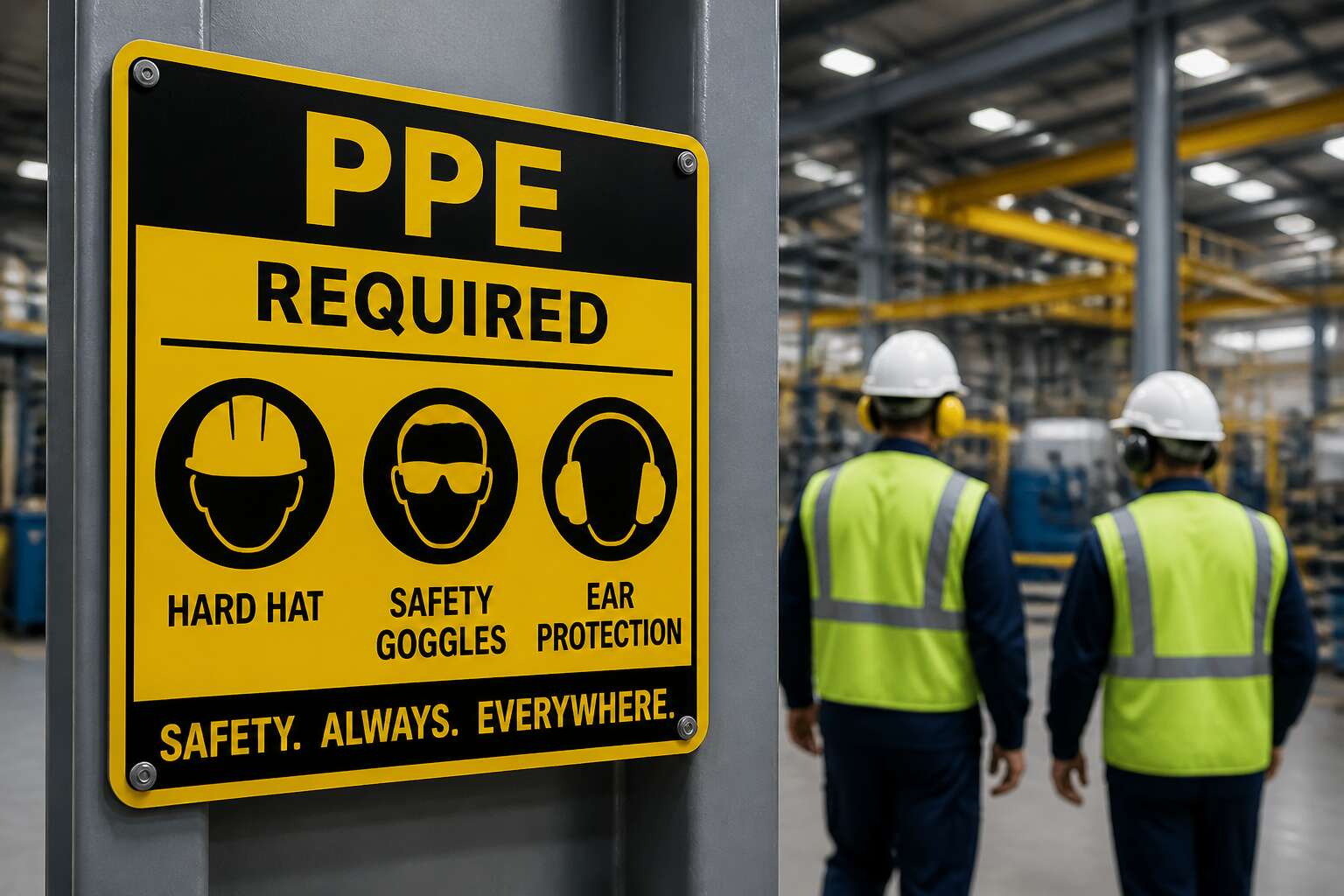
Understanding the Role of PPE Signage in Workplace Safety
Importance of Visual Safety Communication
A sign is not a suggestion. It separates safe practice from fatal error. In South African factories, ppe signs work as the primary tool for hazard recognition. Workers operate in noise, dust, and haste. Their eyes catch a yellow panel before their ears catch a warning shout. This is why visual safety communication matters. It speaks without sound, converting hazard data into simple commands.
From my experience on factory floors, well-placed ppe signs reduce hesitation. They answer two questions instantly: what to wear and where to go. For any sign to function, it must meet specific demands:
- Legibility from a distance
- Clear distinction between mandatory and optional gear
- Consistent placement across all shifts
These details define the role of PPE signage. A worker enters a welding bay. The sign says, wear a face shield. No doubt, no delay! Visual safety communication connects policy to reflex.
How PPE Signs Reduce Accident Risks
Safety officers know the moment a worker hesitates at a door. ppe signs exist to erase that hesitation. They are the on-site expression of every risk assessment report. In South African industries, those yellow panels separate a person from serious injury.
Understanding their role starts with accepting that they are part of a layered system. Training teaches the rules. Signs enforce them at the point of need. They work alongside engineering controls and prompt the final human action.
- Marking entry points for welding bays
- Flagging areas where hearing protection is non-negotiable
- Directing workers to the correct glove for each chemical
This is how ppe signs reduce accident risks. They provide a stationary prompt when noise and dust disrupt memory. Workers glance at the sign seconds before entry. That glance converts training into motion. It stops a worker from skipping a step. A single sign can influence a hundred daily decisions.
Legal Implications of Missing Signage
Ask any safety consultant about the cost of a blank wall. Employers who skip ppe signs rarely remember them until the day an inspector takes photographs. That moment becomes the centrepiece of a negligence claim. Signage is not decoration. It is a legal witness written in warning colours.
South African courts examine whether the workplace told a person what to wear. Without ppe signs, the defence falls apart. I have seen compensation decisions turn on one missing panel. The requirements are concrete:
- Demarcate zones with mandatory head, foot, and eye protection.
- State the exact glove needed for each chemical.
- Show the sequence for donning respiratory equipment.
These panels carry the employer’s promise of safety. Their absence speaks louder than any accident report!
Psychological Impact on Employee Behavior
A worker who sees ppe signs before entering a chemical bay steps differently. Hesitation appears at the threshold. Eyes sweep for hazards. The mind reads a simple message: someone prepared this environment for me, so I owe it the same care.
That reaction builds with repetition. Every encounter with these panels strengthens a mental baseline, a quiet understanding that this workplace demands attention. Workers in well signposted plants report fewer close calls and fewer unsanctioned short cuts. The signage works through steady routine.
Visitors show the same effect:
- Gate markers set expectations for the entire site.
- Zone identifiers tell the brain where risk begins.
- Respiratory sequence panels turn confusion into order.
What follows is measured action. The role of ppe signs is to hold that alertness steady. That is the unspoken agreement between the sign and the person who reads it on a South African worksite.
Key Categories of Personal Protective Equipment Signs
Mandatory PPE Signs
The blue circle with a white pictogram is the most direct order in any workplace. Mandatory PPE signs do not suggest, they instruct. These ppe signs dictate that you wear your hard hat, safety glasses, or respirator before you proceed. In South Africa, where mining and construction drive the economy, ignoring these orders is not an option.
- Head protection signs for sites with falling objects
- Hearing protection signs near high-decibel machinery
- Respiratory protection signs for dusty or toxic atmospheres
- Foot and hand protection signs for industrial zones
Each category uses universal pictograms to bypass language barriers, which matters on our multilingual shop floors. These ppe signs remove guesswork. You see the symbol, you comply.
Prohibition and Warning Signs
Prohibition signs present a clear directive with a red circle and diagonal slash. They forbid actions that could compromise safety, such as entering a confined space without a permit or removing a guard from a moving machine. Warning signs use a yellow triangle to alert workers to hazards like overhead loads or live electrical circuits. These ppe signs do not order action; they signal danger.
- Prohibition: no smoking near flammable storage
- Prohibition: no entry without a gas test
- Warning: caution, wet floor
- Warning: high voltage area
On South African sites, the distinction matters. A warning sign tells you that a risk exists. A prohibition sign tells you to stop. Both categories appear alongside mandatory PPE signs, yet they serve different roles. Reading these signs correctly prevents incidents before they start.
Emergency Equipment Location Signs
A fire extinguisher hidden behind a machine is useless in a crisis. Emergency equipment location signs exist to prevent that failure. They do not command action or warn of danger, they point toward resources. A green square signals a fire extinguisher, an emergency shower, or a first aid kit. These ppe signs remain unnoticed until an incident occurs. Then they determine whether a worker finds help in seconds or loses time.
A well placed emergency sign must remain legible across a noisy factory floor:
- High contrast colours against industrial backgrounds
- Symbols readable without language proficiency
- Positioning at eye level along evacuation routes
This category of ppe signs answers the question of where, not what. A worker who knows a hazard exists, and knows which protection to wear, still needs to locate the equipment that saves a life. On South African sites, work areas can stretch across hectares. In an emergency, a worker cannot afford to search.
Combination Signs and Hazard-Specific Icons
A control board crowded with symbols can still hold clarity, provided those glyphs speak the same language as the hazard itself. Combination signs merge two commands into one visual statement: the danger posed and the gear required. They compress a paragraph of instruction into a single glance, a feat that matters when a hand reaches for a valve or a hoist.
Hazard-specific icons carry the load where words fail. A skull marks poison; a flame marks combustibility; a radiation trefoil marks exposure. These marks bypass literacy entirely.
– Corrosive liquid icons for chemical plants
– High voltage bolts for electrical substations
– Biohazard trefoils for medical or laboratory zones
On South African sites, where crew members may speak several languages, these ppe signs function as universal shorthand. They do not replace training but reinforce it. They are the silent third party in every safety briefing, and they never forget their lines.
Best Practices for PPE Sign Design and Visibility
Color Codes and Symbol Standards
Many accidents begin not with a missing sign, but with a sign that is unreadable. I have walked through plants where a mandatory notice blended into a painted wall. The best ppe signs demand high contrast and disciplined placement.
In South Africa, SANS 1186 and ISO 7010 set the color codes. Red signals prohibition, yellow warns of hazards, blue mandates protective equipment, and green identifies emergency exits. Symbols must match these standards exactly, because a worker who misreads a pictogram loses seconds.
- Position each sign at eye level, perpendicular to the main path of travel.
- Check visibility under the same lighting conditions that workers actually face, including night shifts.
- Replace any sign with faded colors, cracked surfaces, or outdated symbols.
Small refinements in contrast and placement turn ppe signs from passive labels into active safeguards. That clarity makes a workplace safer.
Sizing and Legibility Guidelines
The distance between a worker’s eyes and a sign determines its minimum letter height. Every 25 metres of viewing distance requires 25 millimetres of pictogram height. I have seen factories where a 20 centimetre sign hangs above a warehouse aisle meant for forklifts. The sign was correct in every other way, yet useless.
Sizing ties directly to legibility. A bold sans serif font works best, and ppe signs depend on that clarity. Avoid italics or decorative typefaces, especially for numbers. Workers glance at these details while moving.
Also consider the viewing angle:
- Mount signs at eye level, 150 to 170 centimetres from the floor.
- Use matte finishes to prevent glare.
- Test readability from the farthest point a worker would reasonably see the sign.
Reflective sheeting helps at night, but only if the material meets SANS standards. When size and finish work together, ppe signs communicate before a worker slows.
Placement Strategies for Maximum Exposure
In South African factories, a misplaced ppe sign is more dangerous than none. It promises care where the hazard waits in shadow. Placement and design are rituals of visibility. Mount the sign at eye level, between 150 and 170 centimetres, where a worker already looks. Give it clear space, away from posters, switches and dangling chains. Use matte surfaces so the morning sun cannot erase the message. In corridors used by forklifts, repeat the sign at intervals, not just at the entrance. A worker notices a ppe sign twice, once from the corner of the eye, once from recognition. The second glance is the one that stops the hand before it reaches the wrong lever. Design for that moment.
Durability and Maintenance of Sign Materials
A faded ppe sign is a liability wearing the uniform of safety. In South African industrial settings, the sun does not negotiate. UV rays break down cheap vinyl in months, turning bold red warnings into pale pink suggestions. Choose materials built for the climate: rigid PVC for indoor zones, aluminium composite for outdoor exposure, and anti-graffiti laminates for high-traffic areas.
Visibility depends on more than placement. A sign that sags, peels, or collects grime stops being a message and becomes furniture. Establish a maintenance rhythm:
- Inspect signs monthly for cracks, peeling, or discolouration.
- Clean surfaces with mild detergent, never abrasive pads.
- Replace any sign showing visible wear, especially prohibition and emergency equipment signs.
Durability is not an afterthought. It is the difference between a sign that saves a hand and one that simply hangs there, quietly failing. When ppe signs are treated as disposable, the message they send is that safety is disposable too.
Illumination and Reflective Options
A sign that cannot be seen at 3 a.m. might as well not exist. Luminescence solves the blackout problem. In low-light environments, photoluminescent ppe signs absorb ambient energy and release it over hours. Reflective sheeting catches torch beams and vehicle headlamps, throwing warnings back at the viewer.
Design best practice demands contrast under all conditions. High-contrast pictograms on matte backgrounds reduce glare. Glossy finishes cause specular reflection in direct sunlight, washing out the message. For dark zones, consider:
– Photoluminescent substrates for emergency egress routes
– Class 1 reflective film for night-time hazard identification
– Edge-lit LED signage for dim warehouses
The visible spectrum is only the start. Infrared and UV damage degrade materials over time. A ppe sign that performs at noon may fail at midnight unless illumination is engineered, not assumed.
Regulatory Standards Governing PPE Signage
OSHA Requirements for PPE Communication
Forty percent of workplace injuries involve missing or unclear safety messaging. In South Africa, the Occupational Health and Safety Act requires clear hazard communication, while OSHA sets the benchmark for PPE compliance worldwide. Employers who ignore these standards face fines and, worse, preventable accidents.
OSHA’s PPE regulations mandate specific signal words, colours, and symbols. Signs must identify the hazard, the required protection, and the consequence of non-compliance. The South African Bureau of Standards echoes these rules, ensuring sector-wide consistency. A compliant ppe signs programme covers:
- Respiratory protection signage
- Eye and face protection warnings
- Foot and hand hazard markers
Auditors inspect ppe signs during routine checks. Missing equivalents can halt operations immediately.
ANSI Z535 and ISO 7010 Compliance
A sign that fails to follow a recognised standard is not a safety sign, it is decoration. ANSI Z535 and ISO 7010 exist to remove guesswork from ppe signs. ANSI Z535 prioritises text and colour blocks, while ISO 7010 relies on pictograms that cross language barriers. South African operations that export goods or host international contractors must reconcile both systems.
The differences are not cosmetic. ISO 7010 uses blue circles for mandatory actions, yellow triangles for warnings, and red circles with slashes for prohibitions. ANSI Z535 uses similar logic but permits more wording. Auditors check that signage follows one framework consistently. Mixing standards on a single site creates confusion and weakens compliance.
- Verify which standard applies to your sector.
- Train staff to interpret pictograms before they rely on text.
A facility cannot claim compliance when its ppe signs borrow elements from both systems without a clear hierarchy.
Industry-Specific Regulations (Construction, Healthcare, Manufacturing)
In South Africa, each industry answers to different regulatory masters. The Construction Regulations 2014 require ppe signs that respond to site-specific hazards, including falling objects and welding flash. Healthcare facilities must reconcile the OHS Act with the National Health Act, where visual warnings direct staff toward airborne precaution zones and chemical storage areas.
Manufacturing operations face a separate compliance matrix, governed by SANS 11859 and factory inspector expectations. A food processing plant requires different signage than a foundry. The overlap between these regimes creates practical challenges for safety officers:
- Construction sites need hazard communication that adapts as risk zones shift during the work phase.
- Healthcare facilities require legible warnings across wards, laboratories, and isolation units.
- Manufacturing plants must refresh safety signage whenever production lines change or machinery is introduced.
Department of Employment and Labour auditors assess sector-specific compliance, treating ppe signs as verifiable evidence of a functioning safety system.
Training Requirements Linked to Signage
A safety sign that nobody understands is just a coloured rectangle. In South Africa, ppe signs gain legal meaning only when workers receive training aligned with their placement. The OHS Act and SANS 10244 require employers to demonstrate this connection through documented instruction. Employees must interpret each message, recall its consequences, and act accordingly. The Department of Employment and Labour assesses that linkage during inspections. Training sessions should cover several specific elements:
- Recognition of colour codes and symbol meanings.
- Location of mandatory equipment relative to each ppe sign.
- Procedures for reporting damaged or missing signage.
- Emergency response protocols highlighted by warning signs.
Refresher training must occur whenever regulations update or site hazards evolve. Auditors look for evidence that instruction matches installed signage. Without that, ppe signs become decoration rather than protection.
Evaluating the Effectiveness of Your PPE Sign Program
Conducting a Signage Audit
Silence in a workplace can be deceptive. A sign that has hung untouched for years may no longer speak to the workers who pass it daily. Evaluating the effectiveness of your ppe signs requires a deliberate inspection of your facility, a signage audit that questions every faded pictogram and rusted frame.
During this audit, examine the signs as a stranger would. Note where they fail to capture attention. Consider whether the message survives the dim light of the early shift and the grime of industrial air. The audit should inspect each element:
- Visibility from the expected approach path
- Legibility after prolonged exposure to weather
- Consistency with the latest safety standards
South African workplaces, from Johannesburg workshops to Durban harbours, demand rigorous attention. Your ppe signs must earn their place through constant verification. Without this scrutiny, even the most compliant signage becomes overlooked until the moment it matters most.
Employee Feedback and Safety Observations
South African workers have an uncanny talent for ignoring what they see daily. The safety officer walks past the same ppe signs for the hundredth time and stops noticing them. But the cleaner who mops beneath that sign might see something different. Ask them. The forklift driver, the maintenance technician, the temp worker on their first shift. Each sees what the compliance manual misses.
Employee feedback turns a signage programme into a working system. When workers report that a pictogram is unclear or a sign sits behind a stack of pallets, you have data. Safety observations give you the information to adjust placement, wording, or contrast.
- Do workers glance at the ppe signs or walk through the doorway without breaking stride?
- Do they ask questions about symbols that should be obvious?
A chat at the tea trolley yields more truth than a compliance checklist.
Updating Signs to Address Emerging Hazards
Evaluating the effectiveness of your PPE sign programme requires more than a quarterly glance. It demands comparing incident data, near misses, and worker behaviour over time. A sign that was clearly visible last year may now hide behind new racking or a repurposed doorway. When did you last walk your facility without assumptions and look at what is actually in sight?
Effectiveness is also about response. If workers still enter the hard hat zone without hesitation, the sign may be communicating the wrong message, or the hazard profile has shifted. New equipment, new chemicals, new shift patterns all change the risk profile. A minor hazard six months ago can become critical today.
Consider how frequently your environment changes:
– New machinery adds pinch points and noise levels
– Seasonal rainfall creates slip hazards near entrances
– Load shedding schedules alter lighting and traffic flow
These changes demand constant review. Otherwise, ppe signs become disconnected from the risks they are meant to flag.
Measuring Compliance Rates and Incident Reduction
Most safety managers can recite their sign inventory, yet they cannot name a single compliance rate. Your ppe signs might be perfectly placed, but without measurement they are guesses. Compliance rates and incident reduction are the two quantifiable outcomes that tell you whether the signage actually works!
- Daily violations by zone
- Incident reports before and after sign installation
- Near misses where a sign was present but ignored
Incident reduction matters most. The signs either lower accident numbers or they don’t. In South African settings, load shedding and seasonal rain can skew weekly data, so monthly trend lines are more reliable than a single audit.


0 Comments