
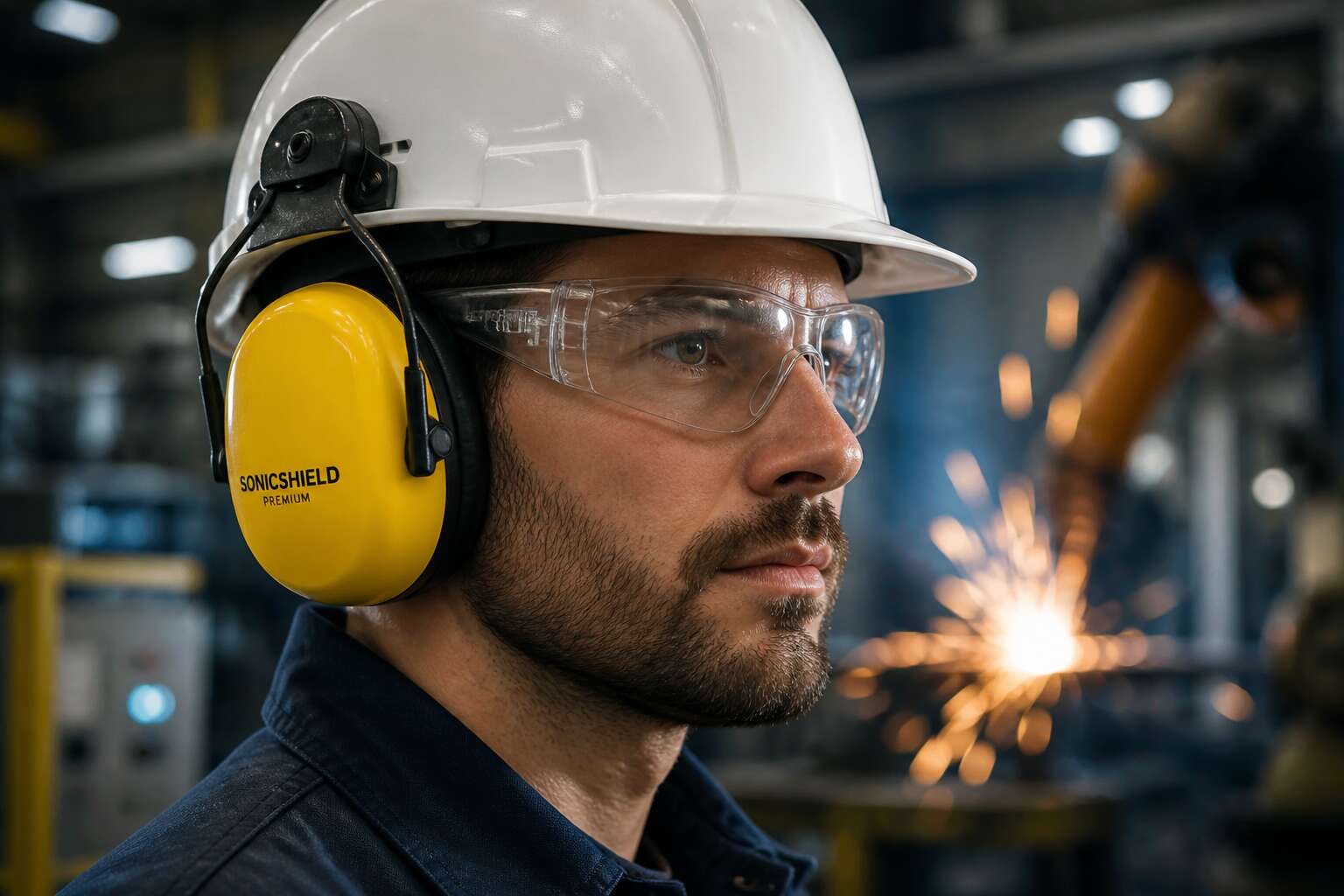
Understanding the Importance of Hearing Safety
Noise-Induced Hearing Loss Explained
Every day, thousands of factory workers and construction crews across South Africa are exposed to noise levels exceeding 100 decibels! Without ppe ear protection, this exposure can permanently damage the delicate hair cells inside your inner ear, a process known as noise induced hearing loss. The tragedy is that these cells never regenerate. Once you lose them, the silence is permanent.
From my experience, what makes this condition insidious is its cumulative nature. You might not notice anything wrong for years, but each unprotected exposure reduces your auditory capability. By the time tinnitus or muffled speech becomes obvious, significant damage has already occurred.
- Prolonged exposure above 85 dB triggers physical fatigue in the cochlea
- Repeated trauma leads to neural pathway degeneration
Investing in ppe ear protection is the only way to prevent this outcome. You face a gradual, irreversible loss of your ability to connect with the world through sound.
Common Workplace Noise Hazards
The roar of a mining drill, the relentless clatter of a stamping press, the whine of a circular saw. These are the soundtracks of South African industry, and they are far from benign. Pinpointing which specific noise poses the greatest threat is often the first hurdle in workplace safety. Many environments create a constant cacophony, where the sheer volume of ambient sound makes it difficult to identify a single source, creating a false sense of security about the overall risk level that demands the use of ppe ear protection.
Common risky environments usually involve:
– Pneumatic tools like jackhammers and impact wrenches
– Metal-on-metal contact in foundries and fabrication plants
– High-speed machinery in textile mills and food processing lines
– Diesel engines running continuously in confined loading bays
The hazard lies in both the intensity and the duration of exposure. A single gunshot can cause immediate trauma, but the subtle, persistent hum of a faulty motor is equally dangerous. It is this cumulative effect that workers must respect. Without proper ppe ear protection, you are not just battling a nuisance, you are participating in an uncontrolled experiment with your own biology. Recognising these daily threats is the first step, and consistently wearing the right protection is the only practical defence.
How Loud Is Too Loud? Decibel Basics
The decibel scale is logarithmic, not linear. A jump from 80 to 90 dB carries ten times more acoustic energy. For South African workers, this distinction means the difference between a manageable shift and permanent damage.
The occupational limit sits at 85 dB averaged over eight hours. Exceed that threshold and the inner ear’s hair cells distort and die. Nobody feels this happening, which is why many workers skip ppe ear protection entirely. The ears offer no warning until the hearing is already gone.
Common reference points:
- Normal conversation: 60 dB
- Busy street traffic: 80 dB
- Industrial press: 100 dB
- Jackhammer at close range: 110 dB
At 100 dB, damage can begin within fifteen minutes, faster than most people realise! That is why ppe ear protection is not optional. We treat this as a logistical inconvenience until the audiogram shows otherwise. By then, the damage is permanent.
Types of Hearing Protective Equipment
Earplugs vs. Earmuffs: Pros and Cons
Your ears do not warn you before they break. On a noisy worksite, the choice between earplugs and earmuffs shapes your long term hearing. Earplugs fit inside the ear canal. They are compact, inexpensive, and work well with helmets. They require clean hands and correct insertion. Earmuffs cover the whole ear with a padded seal. They are quick to put on and easy to check visually, but they can become uncomfortable in heat.
Neither type serves every situation. I have seen workers trust a certain plug until a fit test proves otherwise. Your tasks, your head shape, and the noise levels all factor in. Selecting the right ppe ear protection requires honest assessment. Consider the trade-offs:
- Earplugs suit confined spaces and hot environments.
- Earmuffs offer easier fit checks and consistent pressure.
Without a proper seal, either option fails. That failure arrives silently, long before the ringing starts.
Reusable and Disposable Earplug Options
The humble foam earplug rarely gets a second thought. That is precisely the problem. It expands, fits, and gets discarded without ceremony. Reusable plugs ask for more. You wash them, store them, and keep them close. The former suits short shifts, the latter suits a steady routine.
Here is the honest breakdown:
- Disposable foam plugs handle dusty environments where cleanliness is difficult to maintain.
- Reusable plugs hold up for daily wear where consistency matters.
- Either type fails if you never actually insert them correctly.
Choosing the right ppe ear protection matters only if you wear it properly. Do not mistake comfort for protection. A plug that sits too deep in your ear canal is not a sign of success. It is a sign of poor technique.
Banded Ear Plugs for Intermittent Use
Banded ear plugs hang from a spring loaded band that rests around your neck or over your head. They suit work where noise exposure comes and goes throughout a shift. A worker can drop them the moment a loud machine stops, then snap them back before the next cycle starts. This is ppe ear protection designed for stop start environments.
Common styles differ by how the band sits:
- Headband models loop over the crown of your skull.
- Neckband models tuck under a hard hat.
The ear tips stay attached to the band, so you will not misplace them. I have seen workers lose foam plugs constantly, but banded sets stay put. The tradeoff is tension. The band must press firmly enough to keep a seal. That tension fades with constant stretching, which is why older units lose their grip.
Electronic Hearing Protection for Clear Communication
Hundreds of thousands of rand are lost annually in South African industry due to miscommunication on noisy floors. Traditional ppe ear protection blocks danger, but it also blocks the human voice. This creates a frustrating tradeoff between safety and the ability to coordinate a task. Electronic hearing protection solves this problem by using built-in microphones and processors.
These devices actively manage the sound you hear. They amplify safe frequencies, such as a colleague’s voice or a warning shout, while instantly compressing hazardous impulse noise like a pneumatic drill or a metal stamping press. The result is a natural soundscape where instructions remain crisp and intelligible without risking your hearing.
This technology works in two distinct formats:
– Level-dependent earmuffs, which use a passive filter to let quiet sounds through and seal against loud impacts.
– Active electronic models that sample ambient noise thousands of times a second and adjust the output instantly.
For a mine surveyor or a plant supervisor who spends entire shifts talking to team members, this is a game changer. You are not wearing a barrier; you are wearing a communication tool that happens to be ppe ear protection. It reduces the urge to remove the device to speak, which is often when accidents happen. The result is fewer shouted repetitions and a heightened awareness of the working environment. Communication becomes a safety feature, not a casualty of protection.
Understanding Noise Reduction Ratings (NRR)
The quietest factories in South Africa still hum at around 85 decibels, a level where the ear begins to surrender its delicate hair cells. Choosing between earplugs and earmuffs is only the first decision a safety officer faces. Each format approaches the same problem from a different angle, and the differences become critical on a noisy floor.
– Earplugs: Inserted into the ear canal, they offer portability and work well under a hard hat or welding visor.
– Earmuffs: Complete cups that seal around the entire ear, providing a consistent fit and easier handling for workers who remove their protection frequently.
– Semi-insert earplugs: Held by a flexible band, these sit at the canal entrance, suitable for intermittent noise exposure.
The Noise Reduction Rating (NRR) is the laboratory measurement that states how many decibels a device can shave off the surrounding din. An NRR of 25 means the protector attenuates the incoming sound by 25 decibels under ideal conditions. Real-world performance, however, often falls short by half. Derating the NRR gives a more honest estimate. A worker standing next to a conveyor at 100 dB with an NRR of 30 can expect roughly 85 dB of actual protection, a subtle but vital calculation for anyone selecting ppe ear protection. Understanding this arithmetic helps you match the device to the true hazard rather than the label on the box.
Selecting the Right Protection for Your Environment
Assessing Noise Levels in Your Workplace
Your ears cannot close. They have no reflex to block out sound, so every shift at a noisy site creates a cumulative exposure that never reverses. The first step is understanding what you are up against. You must measure the environment, not guess it. Here is what that assessment involves:
- Identify the noisiest zones on your site and how long workers stay there.
- Measure peak levels with a sound level meter, not an app on a phone.
- Compare those readings against the legal exposure limits in South Africa.
Only with that data can you select ppe ear protection that actually matches the risk.
Matching NRR to Exposure Requirements
Choosing ppe ear protection without reference to measured exposure is guesswork, and guesswork costs hearing. The NRR printed on a box is only useful when weighed against the actual decibels in your workspace.
For steady noise below 100 dB, a moderate NRR of 22 to 26 gives enough attenuation without isolating the wearer. For environments that produce loud impulses, like pneumatic drills or metal shears, you need a higher NRR, closer to 30 or above. The task duration also shifts the equation, so your ppe ear protection selection must factor in both intensity and time. Here is a practical reference based on common conditions:
- Continuous 95 dB: foam earplugs with NRR 25
- Intermittent 110 dB: earmuffs with NRR 30
These pairings are starting points, not fixed rules. The real match depends on the hearing protection being worn correctly and consistently throughout the shift!
Weighing Communication Needs Against Attenuation
Silence is not always golden. A worker who cannot hear the forklift faces a different hazard. Choosing ppe ear protection means weighing attenuation against communication. I have seen safety managers pick the highest NRR without thinking about speech. Relevant protection beats maximum protection.
Consider your actual tasks! Are you giving hand signals or relying on shouted warnings? If so, look for ppe ear protection with flat attenuation or built-in microphones. Block the noise, not the voice.
Here is a checklist for that balance:
- Identify the exact warning sounds your job depends on.
- Log the peak noise levels you face on a typical shift.
- Choose a model that reduces those peaks but keeps speech clear.
The goal is to stay engaged. Over-protection makes workers remove their gear, which is riskier than a hum. Under-protection damages ears. Find the middle ground where you can hear the shout but still protect hearing.
Comfort and Compatibility with Other Safety Gear
Choosing hearing protection starts with the environment, not the shelf label. In a hot, dusty South African workshop, earmuffs can cause sweat buildup. Workers pull them off during breaks. Foam plugs fail when fingers are greasy. Fit must survive the actual shift.
Compatibility with other safety gear is critical. A hard hat brim can push earmuffs out of position. A respirator strap can land on the headband. Safety glasses arms can break the seal. If the ppe ear protection fights your equipment, it will end up in a pocket. Comfort determines whether workers keep it on. A perfect rating means nothing if abandoned by lunchtime.
Task-Specific Considerations in Different Industries
One size never fits all when it comes to working ears. A foundry operator in Gauteng deals with constant, booming furnaces. A traffic officer in Durban faces sudden sirens and engine roars. The right ppe ear protection changes with the task, not just the noise level.
- Mining: high impact drills and conveyor rumble, so combine earmuffs with dust filters
- Agriculture: tractor cabins and animal sheds, where breathable banded plugs win
- Manufacturing: repetitive presses and compressors, so swap out foam plugs frequently
Task-specific selection also means considering how often workers enter and leave noisy zones. A welder who moves between stations needs quick on and off options. A control room operator needs minimal attenuation to hear alarms. Match the protection to the physical job, not the clipboard reading.
Compliance, Standards, and Employer Responsibilities
OSHA Noise Standard and Hearing Conservation
The OSHA Noise Standard is a mandatory regulation, not a suggestion. When average noise levels hit 85 decibels over an eight hour shift, compliance is non-negotiable. Employers must establish hearing conservation programs that include access to ppe ear protection at no cost, and they must also:
- Conduct baseline and annual audiometric testing
- Provide training on hazardous noise and proper wear
- Maintain meticulous records for regulatory review
However, distribution is not the endpoint. You must verify usage through routine spot checks and enforce adherence without exception. The standard has real enforcement consequences, so treat it as a standing obligation rather than a routine formality.
Key Elements of a Hearing Conservation Program
A hearing conservation programme that exists only on paper protects nobody. The decisive moments are unglamorous. A supervisor notices a worker remove an earplug for the third time. A quarterly review catches a noise map misaligned with new machinery. A worker finds the ppe ear protection uncomfortable but wears it anyway. I have seen compliance fail in these small gaps more often than in the hearing test booth.
The key elements extend beyond distribution:
- A designated programme administrator with authority to stop work when protection fails.
- Procurement standards that guarantee consistent supply of ppe ear protection, so a worker never improvises with cotton wool or a rolled-up cloth.
- Annual programme evaluation that examines incident data, audiometric shifts, and informal feedback from the floor.
These elements matter under South African occupational health regulations. The employer who applies and audits them daily transforms a standing obligation into a safeguard that preserves hearing.
Employer Obligations for Noise Monitoring and Training
In South Africa, the employer’s duty begins with accurate noise monitoring, not assumptions. The Noise Induced Hearing Loss Regulations under the Mine Health and Safety Act require baseline risk assessments that capture real shift conditions, not a single snapshot on a quiet day. Noise mapping must reflect machinery changes, production cycles, and warehouse layouts.
Training obligations carry equal weight. I have watched workers treat hearing protection as a nuisance because nobody explained the consequences. Workers need to understand why ppe ear protection matters, how to fit it correctly, and what happens when attenuation fails. Theoretical instruction in a boardroom does not translate to the factory floor. Practical demonstrations, fit testing, and refresher sessions tied to actual exposure levels build competence.
- Conduct noise surveys at least every two years or after any process change.
- Train workers in the care and limitations of ppe ear protection.
- Document all monitoring and training for inspection.
An employer who treats these duties as paperwork invites avoidable claims. Verification of noise levels and worker behaviour closes the gap between policy and practice.
Employee Rights and Responsibilities for Proper Use
Compliance is a legal threshold in South Africa, not a corporate sentiment. The Noise Induced Hearing Loss Regulations demand certified ppe ear protection, fitted to the individual and maintained between shifts. A product that fails its rated attenuation fails before the first machine starts. Employers must enforce use, not merely supply items. I have seen cabinets full of intact earmuffs that never protected anyone.
Employees hold rights that mirror those duties. You may request a different model when the fit compromises the seal. You may examine the noise survey records that justify the chosen protection level. You may refuse a task where adequate ppe ear protection has not been provided.
Those rights carry obligations:
– Wear the equipment for the full duration of exposure.
– Check for cracks, compression and debris before each use.
– Report damage instead of accepting a broken seal.
A small defect becomes a permanent loss. Noise erodes without warning. The law sets the standard; the wearer supplies the discipline.
Fit Testing and Verification Methods
A protector that fails the fit test fails the worker. In South Africa, compliance demands more than handing out equipment. Fit testing isolates the gap between theoretical attenuation and real world performance. We see muffs that sit crooked, plugs that ride loose, and seals that break with every nod.
Employers must verify before the shift, not after the claim. Use objective methods. Check the seal with a fit test system. Check the insertion for earplugs. Check the suspension for muffs.
- Field attenuation estimation tests for earplugs
- Acoustic seal checks on earmuffs
- Training drills that simulate full shift wear
Each method feeds the records. Each failure triggers a new fitting. This is how ppe ear protection becomes a reliable control, not a shelf ornament.
Proper Use, Care, and Maintenance
Step-by-Step Earplug Insertion Technique
Most hearing damage happens because earplugs are worn incorrectly. Even the best ppe ear protection fails when you skip proper technique. Here is the step-by-step method that works.
- Roll the foam plug into a thin, crease-free cylinder.
- Reach one hand over your head to pull the ear upward and back.
- Slide the plug deep into the ear canal.
- Hold it in place for 20 seconds while the foam expands.
Clean hands before insertion. Dirty plugs carry debris into the ear. Replace reusable plugs when they harden or lose shape. Store them in a sealed case away from heat and moisture.
Cleaning and Storing Reusable Hearing Protectors
According to a 2019 study, improperly stored earplugs harbour more bacteria than a toilet seat. That’s why proper use of ppe ear protection extends far beyond insertion. Cleaning and storing reusable hearing protectors is a daily ritual, not an afterthought. I have seen workers toss plugs into dusty toolboxes, then wonder why their ears itch.
For cleaning, use mild soap and warm water. Never solvents, which degrade the material. Rinse thoroughly and let plugs air dry completely. Moisture trapped inside a case creates a breeding ground for microbes. Store your ppe ear protection in a ventilated container, away from sunlight and heat. A sealed plastic bag is a mistake. Consider these storage habits:
- Keep the case in a cool, dry locker, not on a hot dashboard.
- Check for cracks or hardening before each shift.
- Replace plugs that no longer spring back to shape.
Recognizing Signs of Wear and Damage
The quiet degradation of ppe ear protection often goes unnoticed until it fails completely. Foam plugs lose their memory, seals crack microscopically, and attenuation drops without visible warning. A protector that looks acceptable may offer a fraction of its rated performance.
Inspect every component before each shift. Compression set, where foam fails to spring back, signals immediate replacement. Hardening from heat exposure ruins the acoustic seal. Discolouration from UV light weakens the material, though ordinary grime also stains. A torn flange on a banded plug or a distorted earmuff cushion compromises the entire system. Workers assume protection remains constant. It does not.
- Foam plugs that remain compressed after rolling
- Cracks or tears in the stem or flange
- Earmuff cushions that have lost their pliable
- Headbands with hairline fractures
Rough usage accelerates damage. Dropping plugs onto contaminated surfaces or shoving them into pockets invites both structural harm and microbial growth. Recognising wear demands deliberate attention. If ppe ear protection fails, the consequence is irreversible. The rubber stiffens, the plastic crazes, the foam crumbles. Replace suspicious items without hesitation. Spares cost little; hearing costs everything.
Replacement Schedules for Different Types
Proper use starts with clean hands. Even trace oils transfer to foam and harden the material over time. Disposable foam plugs get replaced daily, or sooner if they look soiled. Reusable silicone plugs might last three months, but only if you store them in a ventilated case, not in a pocket or on a dusty workbench.
- Disposable foam plugs: replace after every shift
- Banded plugs: change the pods every three months
- Earmuffs: replace cushions and inserts every six months
Earmuffs require more attention. Sweat degrades the cushion foam, so the headband tension slackens. Set a calendar reminder, not a guess. The ear itself changes little over a year, but the ppe ear protection changes plenty. Write the purchase date on the headband with a marker so nobody debates whether the gear is still within its service window.
Common Mistakes That Reduce Protection Effectiveness
A hearing protector only works if it stays exactly where you put it. The most common mistake is shifting the device mid-task, even for a few seconds, to catch a word or answer a phone. This interruption breaks the acoustic seal and instantly exposes you to the full noise level. Worse, many workers then forget to re-seat the protector properly, leaving a gap that silently defeats the entire purpose. Good ppe ear protection demands vigilance, not just initial insertion.
Earmuff seals suffer from a hidden enemy: daily friction against hard hats and respirator straps. This action creates tiny channels that leak sound at high frequencies. A second frequent error involves modifying the gear. Drilling holes in earmuff cups for ventilation or trimming foam plugs to reduce pressure ruins the engineered attenuation. These alterations void the NRR rating and leave you with a false sense of security. Also, in South Africa’s humid climate, condensation inside the ear cup breeds bacteria; pairing that with worn cushions creates an unpleasant fit that workers remove too often. Proper ppe ear protection includes replacing sealing surfaces on schedule and checking the headband tension monthly.
Consider these common mistakes:
– Wearing plugs intermittently, only when the noise feels loud
– Storing earmuffs in direct sunlight, which degrades the plastic
– Looping the headband under a chin instead of over the crown
– Ignoring a persistent whistling sound that indicates a poor fit
These issues are preventable with routine checks. The physical act of inserting and fitting is only half the battle. Consistent, uninterrupted wear is the other half.


0 Comments