
Understanding Arc Flash Hazards
Defining Arc Flash and Arc Blast
In South Africa’s electrical sector, few phenomena are as unforgiving as an arc flash. It occurs when current leaps across an air gap instead of its intended path. Temperatures at its core can reach four times the sun’s surface, hot enough to vaporize metal. Understanding this hazard is the foundation of any serious approach to electrical safety.
An arc blast is the pressure wave accompanying the flash. It can throw a worker across a room. Injuries stem from multiple vectors.
- Intense radiant heat that ignites clothing
- The pressure wave that ruptures eardrums
- Molten copper and shrapnel propelled at high velocity
Differentiating between the flash and the blast matters because each requires a specific layer of protection. The flash alone can cause fatal burns, while the blast inflicts blunt trauma. South African electrical workers must respect both,and knowing how to survive arc ppe starts with recognizing these dual threats.
Common Causes and Contributing Factors
Arc flash incidents do not happen randomly. They follow predictable patterns. Human error, equipment failure, and environmental conditions all contribute. Dust and moisture can create conductive paths on insulators. Corroded connections increase resistance, producing heat that weakens components. A dropped tool might bridge phases. Even routine maintenance, when performed without proper isolation, can initiate an event.
Common contributing factors include:
– Poor maintenance practices that allow contaminants to accumulate
– Improper work procedures, such as testing live equipment without verification
– Voltage transients caused by lightning strikes or switching operations
The age of South Africa’s electrical infrastructure also matters. Older installations may lack modern protection devices. Workers who understand these causes can better appreciate why survive arc ppe requires more than wearing the right gear. Awareness of hazards precedes protection.
Severity of Burn Injuries and Fatalities
A fraction of a second near an arc flash can turn human tissue to carbon. Temperatures exceeding 19,000°C vaporise copper conductors and burn through multiple layers of cotton clothing. In South Africa, electrical workers survive these events only to face months of reconstructive surgery. Some never leave the hospital.
The damage extends beyond the skin. The pressure shockwave from an arc blast ruptures eardrums, collapses lungs, and fractures bones. Workers thrown backwards onto concrete suffer head trauma as well. These injuries compound the burns, making survival far less certain.
The severity of these injuries is ranked by their immediate threat to life:
- Third degree burns destroying nerve endings and underlying tissue
- Blunt force trauma from the concussive blast wave
- Respiratory damage from inhaling vaporised metal particles
Technicians who respect this destruction understand that survive arc ppe stands between them and these outcomes. Without properly rated protection, an event survivable in theory becomes fatal in practice.
Performing an Arc Flash Risk Assessment
Understanding a hazard is the first act of survival. An arc flash hazard exists whenever electrical energy is present, but its true measurement lies in incident energy, expressed in cal/cm². South African compliance engineers rely on fault-level studies to map these dangers.
Performing an arc flash risk assessment follows a deliberate sequence:
- Inventory the network and identify all operational modes.
- Model fault currents and protective device clearing times.
- Calculate arc flash boundaries and energy levels.
- Assign risk categories and select appropriate clothing.
Each step narrows the margin between a worker and catastrophe. A risk assessment is only as good as its field verification, and when the analysis is honest, the selected gear will survive arc ppe standards. Choosing survive arc ppe that matches the calculated energy gives technicians a definite advantage. They do not work on faith. They work on numbers.
Arc Rated Clothing and Layering Systems
Arc Rated Garments and Fabrics
Imagine standing next to a lightning strike that happens to wear a hard hat. An arc flash can exceed 19,000°C. To survive arc ppe, you need more than a cotton tee and good intentions.
Layering systems in arc rated garments work through separation. The base layer wicks moisture, keeping your skin dry. The mid layer provides insulation. The outer shell absorbs the thermal blast. Each layer must carry the correct arc rating. Mixing non compliant fabrics can turn your wardrobe into a hazard.
- Base layers: flame resistant natural fibres like merino wool
- Mid layers: arc rated fleece or knit
- Outer layers: arc rated coveralls or jackets
Check the ATPV rating on every piece. In South Africa, heat and humidity make layering feel like punishment. The right system lets you survive arc ppe without compromising comfort.
FR Shirts, Pants, and Coveralls
Standing in a Johannesburg substation, the heat makes you want to strip down, but the system matters most! FR shirts and pants form the first line of defence, while arc rated coveralls add a second barrier. The goal is not piling on fabric; it is matching each layer to the calculated incident energy.
I tell workers to inspect every garment before work. A torn seam exposes skin. Here is what I check:
- Arc rating on each layer, including the coverall
- Coverall fit over shirts and pants without bunching
- FR zippers and closures that stay closed under stress
When your layers work together, you can survive arc ppe even in the Highveld heat. The right shirt, pants, and coverall combination manages moisture and keeps the arc energy away from your body.
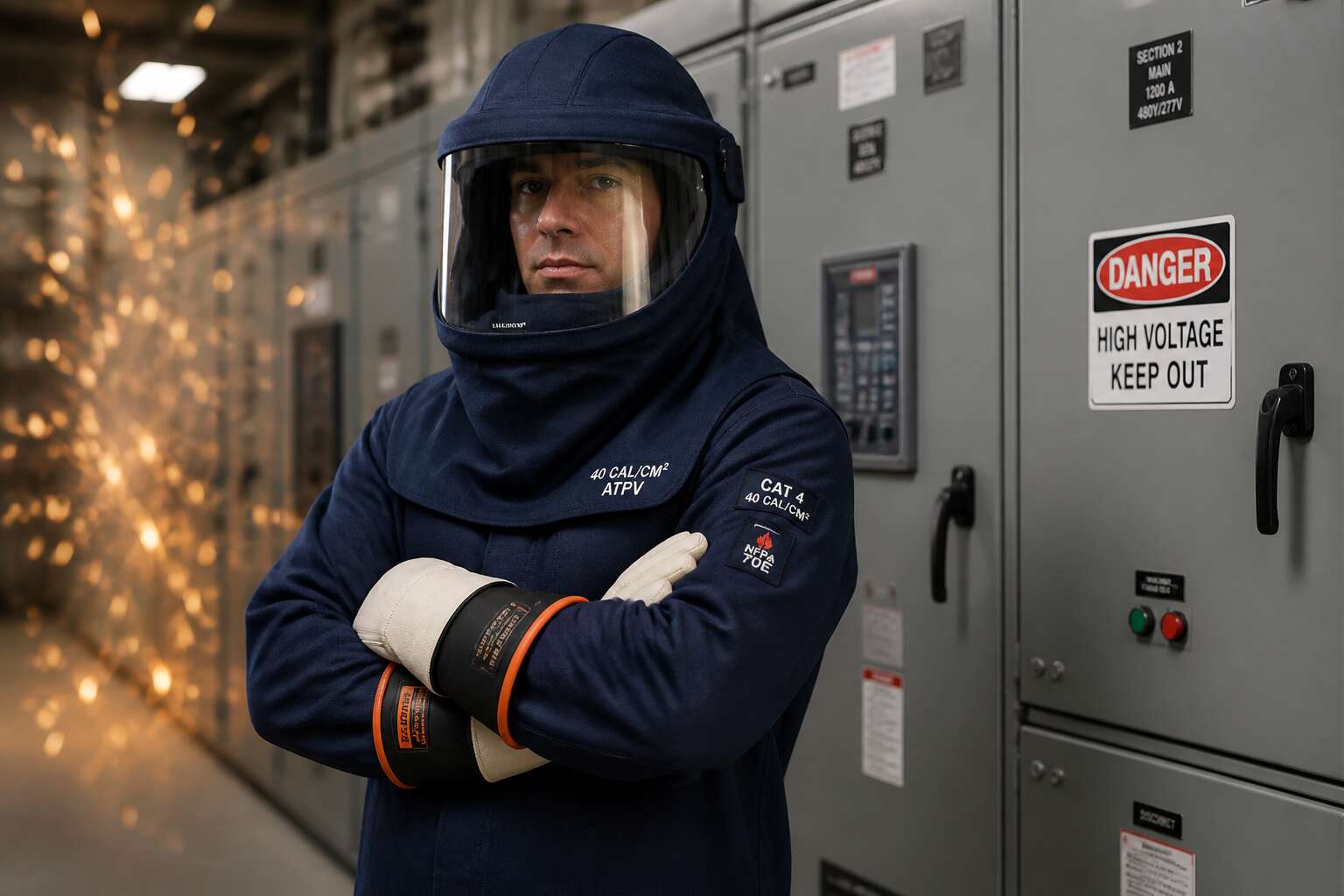
Arc Flash Suits and Hoods
Arc rated clothing works as a system. The layering principle means each piece adds thermal resistance while preserving mobility. You might combine a lightweight shirt with a heavy coat, but only if both are tested together. When the incident energy exceeds what layers can handle, you step up to an arc flash suit and hood. This full ensemble creates a microclimate, making you sweat before the event occurs.
To survive arc ppe under high energy conditions, verify the suit’s arc rating matches the hazard analysis. Check the hood’s visor for clarity and the seams for integrity. Here is what I confirm each shift:
- Overall system rating on the label
- Hood overlap with the coat collar
- Elastic cuffs and closures that seal reliably
Even the best arc flash suit fails if worn over soaked clothing or with a gap at the neck. The hood’s window must stay clean, and the balance between heat build up and protection requires practice. You are not wearing a shield; you are wearing a calibrated answer to the energy in that room.
Gloves and Voltage-Rated Hand Protection
Your hands reach in first. Voltage-rated hand protection has to survive arc ppe while keeping you nimble enough to work. The rubber glove’s class must match the system voltage, and the leather outer needs to cover the gauntlet entirely. I have seen cracked rubber hidden by clean leather. That is how a simple task turns into a serious injury.
Layering systems apply to gloves as well. A thin liner improves comfort and dexterity under heavy gloves. Arc rated clothing relies on tested combinations, and hand protection follows the same rule. Never pair gloves that were not designed to work together!
- Verify the voltage class and rating on each glove.
- Perform a visual and air test for punctures.
- Check that leather protectors seal over the cuff.
Those checks take two minutes. Survive arc ppe means respecting the most exposed part of your body, not assuming your gloves are fine.
Footwear and Headgear Essentials
Every year, South African workers face an invisible threat that can turn a routine shift into a critical incident in a fraction of a second. The statistics around arc flash incidents in our mining and industrial sectors remain sobering, yet the conversation often stops at the torso. The reality is that your feet and head tell a different story when the arc occurs. You can survive arc ppe failures below the waist and above the shoulders, but only with deliberate choices.
Footwear is not an afterthought in this equation. Leather work boots with dielectric properties provide a first line of defence against ground potential. Rubber soles must be free of cuts and embedded metal fragments. Lace-up designs offer superior ankle support when you need to move quickly. The stitching should be continuous and heat resistant. In high risk zones, consider the application of a full overboot system, though these require separate fitting and inspection routines.
- Inspect the boot sole for cracks before each shift.
- Check for exposed metal eyelets that compromise insulation.
- Confirm the boot height meets your company’s PPE standard.
Headgear presents its own quiet challenge. Arc rated hard hats with chinstraps keep the protection in place, but the face shield must not fog or distort your view during a live assessment. The combination of the hood material and the visor needs to meet the current survive arc ppe requirement for your specific fault level. Polycarbonate visors scratch easily, and a scratched visor obscures the very hazard you are trying to control. Ensure the headband is adjusted correctly to prevent the entire assembly from shifting when you look upward toward switchgear. The integration between the hood’s bib and the jacket collar deserves attention, because any exposed skin creates a point of weakness. These details define the difference between proper preparation and a false sense of security.
Selecting Protective Equipment by Hazard Level
Understanding ATPV and Arc Ratings
Most electricians misjudge the gap between a 4 cal and a 40 cal exposure. Selecting protective equipment by hazard level starts with the arc rating, where ATPV tells you the maximum energy a fabric can survive before breaking open. For a level 2 hazard, a single layer with a rating above 8 cal works. For level 4, you need a full suit rated above 40 cal!
- Match the ATPV to the incident energy on your panel.
- Add layers only if each layer is arc rated.
- Replace gear if the rating label fades.
The goal is to survive arc ppe conditions without guessing. I have learned that a higher ATPV always costs more, but a wrong guess costs far more.
Matching PPE to Calorie Exposure
Selecting protective equipment by hazard level requires precision. The incident energy on each panel, measured in calories per square centimeter, dictates your clothing. If sheer number sits at 12 cal, a 4 cal shirt provides no protection. Match your gear’s ATPV to at least that value, including a safety margin.
For a Level 2 hazard, one layerrated above 8 cal works. For Level 4, a full suit above 40 cal is required. Every added layer must carry its own arc rating. Without that, you are stacking risk, not protection. The goal is to survive arc ppe conditions without trusting faded labels. Replace damaged labels before relying on equipment.
Category One Through Four Protection Levels
The hazard category system gives structure, yet it only works when you follow its strict tiers. Category One requires a single layer rated at 4 cal. Category Two pushes that to 8 cal. Categories Three and Four demand 25 and 40 cal, often with multiple layers or a full suit. Here is how those levels translate into practical choices:
- Category One: basic FR shirt and pants
- Category Two: heavier FR coveralls or two layers
- Category Three: multi layer combinations
- Category Four: arc flash suit with hood and visor
Your incident energy study might show a higher exposure, which means the category table alone cannot save you. To survive arc ppe incidents, verify every garment’s actual rating against the calculated calorie level. To survive arc ppe conditions, the category serves as a starting point, not a guarantee. Only disciplined selection, checked against real data, keeps workers safe.
Comfort, Mobility, and Ergonomics
Selecting gear to survive arc ppe means balancing the rating against the physical task. A 40 cal suit blocks extreme energy, but not if the wearer cannot reach the breaker. Restricted movement creates a new hazard.
Ergonomics start with the job. Overhead work demands shoulder articulation. Confined spaces require low profiles. Heat stress compounds the problem on a South African site.
Ask these questions:
- Will the worker be bending or squatting?
- Is the workspace a tight enclosure?
- Does the temperature exceed 30 degrees?
The answers shape the layering. Cotton FR breathes, some synthetics stretch. The hood and visor limit vision, so head movement counts. To survive arc ppe conditions, a worker who cannot move freely will loosen a strap or skip the hood. That is how injuries happen.
Working with Insulated Tools
When hazard levels shift on the same site, your equipment must shift with them. Selecting by hazard level means reading the label, not the colour of the fabric. A 4 cal shirt will not survive arc ppe conditions of 40 cal exposure. Insulated tools offer a separate layer of defence, but they do not replace the suit. I always check the tool’s voltage rating before I reach into a panel. That rating must exceed the system voltage. This sequence keeps a worker alive:
- Confirm the hazard level from the risk assessment.
- Match the arc rated suit to that calorie exposure.
- Use insulated tools rated for the voltage present.
To survive arc ppe events, every layer must be deliberate. The tool handles insulate, but they do not shield against blast. So choose equipment for the worst case, not the routine task. A worker who picks the lowest rated glove because it feels thinner makes a dangerous trade. The hazard level tells you the minimum, and the insulated tool covers the direct contact risk. Both belong in the same hands.
Evaluating PPE Brands and Testing
Choosing gear by brand reputation alone is a gamble. Labels carry weight, but the arc rating is the only number that matters when the arc flash happens. A trusted name can fail if the garment is worn, washed, or rated incorrectly. I have seen workers trust a famous logo and ignore the damage on the fabric. That damage changes everything. The hazard level dictates the minimum performance, and the testing must prove it.
The science is straightforward. The lab simulates an arc event and measures the heat transfer through the fabric. The result is the ATPV or EBT rating. Independent testing matters because it removes the marketing. In South Africa, standard SANS 50503 governs much of this testing. Look for the test report, not the sales pitch.
– Request the test certificate for the exact garment.
– Verify the batch number on the label.
– Confirm the wash cycle count affects the rating.
– Inspect for wear before every shift.
Your survival depends on the fabric’s integrity. That integrity is verified in a controlled environment, not on a warehouse floor. So evaluate the brand, but trust the data. The data tells you if that suit will actually help you survive arc ppe conditions. The label is a promise, and the test report is the proof. Brand loyalty does not stop a blast. Only the right, tested equipment does.
PPE Inspection, Care, and Maintenance
Daily Inspection and Field Checks
Even the finest survive arc ppe becomes a hollow shield when neglected. Inspection is the quiet ritual that separates genuine protection from mere suggestion. Each morning before energised work, examine every seam and closure. Look for scorch marks, frayed edges, or compromised stitching. Field checks are not paperwork; they are your final sentinel.
A systematic approach prevents oversight. Test all zippers and snaps for free movement. Inspect elastic cuffs for lost tension. Turn garments inside out to reveal hidden damage from prior use. Do not trust memory alone. Employ a simple method:
- Check labels for laundering fatigue
- Verify closures align without gaps
- Hold layers up to light for thinning fabric
Store clean, dry gear away from direct sunlight and chemicals. Never fold wet FR fabric, as creases weaken fibres. Follow manufacturer wash cycles without fabric softeners. The arc rating means little when the item stays intact. A torn sleeve or melted button accelerates risk. Daily scrutiny of your survive arc ppe costs minutes yet buys a life.
Laundering FR and Arc Rated Clothing
Laundering FR and arc rated clothing demands more attention than tossing workwear into a domestic machine. Industrial contaminants such as grease and oil compromise the fabric’s protective barrier. A single wash with fabric softener can coat the fibres and diminish flame-resistant properties. I have seen good survive arc ppe ruined by cleaners who ignored the label.
The correct process starts with separating FR garments from ordinary laundry. Use a neutral pH detergent and avoid chlorine bleach. Water temperature should match the manufacturer’s specification. Air drying is safer than mechanical drying, as excessive heat degrades elastic components.
- Turn garments inside out before washing to protect the outer shell
- Remove all items from pockets to prevent hidden contamination
- Check for oil stains before washing and pre-treat them properly
Repeated laundering changes the fabric’s behaviour over time. Shrinkage, colour fading, and lost flexibility signal the garment has reached the end of its useful life. Replacing worn items keeps your survive arc ppe dependable.
Repairing Minor Damage Safely
Catching minor damage early extends the life of your survive arc ppe. A small tear or loose seam might seem harmless, but it compromises the arc rating. Inspect stitching, closures, and fabric integrity after every shift. In South African conditions, heat and humidity accelerate wear, so pay extra attention to stress points like elbows and knees.
For repairs, use only arc rated thread and flame resistant patches. Standard sewing thread burns and creates weak points. If you are unsure, return the garment to the manufacturer. Field repairs are acceptable for minor snags, not structural damage.
- Trim loose threads, never pull them
- Check zippers and snaps for proper function
- Replace damaged hook and loop fasteners
Repaired areas need testing to confirm the arc rating holds. When in doubt, replace the garment. A compromised layer of protection defeats the purpose of survive arc ppe.
Proper Storage and Replacement Cycles
Proper storage is an invisible factor in every survive arc ppe program. In South Africa, coastal humidity and Highveld UV exposure degrade flame resistant fibres faster than most workers realise. Crumpling a garment into a toolbox accelerates failure. I have seen arc rated shirts develop micro-cracks along folds after one humid summer. Hang garments on wide, padded hangers in a dry, shaded cabinet. Sunlight through a window weakens the weave.
Replacement cycles demand documentation, not intuition. Record first wear date, every wash, and any incident exposure. Manufacturers specify maximum repairs and service life. After any arc event, retire the garment immediately. Loose elastic in cuffs signals structural fatigue.
- Inspect storage areas for pests, moisture, and direct light
- Track purchase date, first wear date, and laundry count
- Verify arc rating labels remain legible after each wash cycle
Rotating between two sets of survive arc ppe spreads daily stress, but rotation cannot extend the total certified lifespan. Obsolescence tracking and disciplined storage preserve the thermal barrier you depend on.
Regulatory Standards and Compliance Strategies
Navigating NFPA 70E Requirements
The NFPA 70E standard exists for one reason: to ensure workers survive arc ppe hazards. Yet compliance remains inconsistent across South African industries. The 2024 edition emphasizes risk assessment procedures and the hierarchy of controls, shifting the focus from simply wearing gear to understanding why it is worn.
Consider what the standard actually requires:
- An arc flash risk assessment conducted before any work on energized equipment
- Selection of PPE based on the incident energy analysis, rather than relying solely on task tables
- Documented training and retraining intervals for all affected workers
In my years reviewing electrical safety programs, I have found that these elements constitute a defensible safety programme. Without them, even the finest arc rated clothing offers little legal or practical protection. To truly survive arc ppe compliance audits, treat the standard as a dynamic framework that evolves with each revision.
OSHA and Workplace Electrocution Prevention
NFPA 70E guides the technical side of electrical safety. OSHA enforces the legal baseline. In South Africa, where these standards meet the Occupational Health and Safety Act, compliance demands more than paperwork.
OSHA’s workplace electrocution prevention rules focus on identifying hazards before anyone touches a live conductor. Audits and documented lockout/tagout procedures form the backbone of a credible programme. Without these, workers cannot survive arc ppe hazards because gear alone never substitutes for controlled energy isolation.
Compliance strategies centre on three documented practices:
- Verifying arc rated equipment matches the incident energy analysis
- Scheduling refresher training at fixed intervals
- Reviewing near miss reports to correct gaps before they become injuries
The standard expects employers to prove their methods. Electrocution prevention and arc flash protection share the same root: know the energy, control it, then equip the worker to survive arc ppe. Auditors seek this sequence in every file.
ASTM and IEC Standards Overview
South African employers often ask which standard carries more weight, ASTM or IEC. The honest answer is that both shape how you survive arc ppe hazards, but they do so from different angles. ASTM F1506 governs flame resistant clothing materials, while IEC 61482 specifies testing methods for thermal hazards. Each one feeds into your risk assessment process.
Compliance strategies should treat these standards as complements, not rivals. A garment that meets ASTM requirements might still fail IEC’s open arc test. Auditors look for documented evidence of both.
- Verify test labels against your incident energy analysis
- Cross reference ASTM and IEC ratings before purchasing
- File certificates with your electrical safety programme
When your PPE programme aligns with both frameworks, workers gain a measurable margin to survive arc ppe events. That is the practical benefit of standardisation.
Record Keeping and Program Audits
Record keeping is the backbone of any electrical safety programme. Without documented proof, your compliance efforts remain invisible. Audit findings often reveal that missing certificates or outdated test labels lead to failures. To survive arc ppe audits, every garment must trace back to a purchase order, a test certificate, and a worker sign-off.
Program audits should happen annually, not every three years. Review your incident energy analysis against current arc rated clothing inventories. Check that replacement cycles align with manufacturer guidance. A simple checklist ensures nothing slips through:
- Verify arc ratings match the calculated hazard level
- Confirm employee training records are current
- Inspect storage conditions for physical damage
When these records sit within an auditable system, you can prove compliance during reviews. That is the purpose of disciplined record keeping.
Managing Contractor and Vendor Compliance
Contractors arrive on site with their own kit, their own habits, and often their own interpretations of safety. A worker who has never passed a South African electrical qualification might still be expected to survive arc ppe hazards. Vendors who supply arc rated gear must prove their products meet SANS and IEC standards without relying on a generic datasheet.
Set baseline requirements before anyone steps onto the floor. Demand test certificates, training records, and proof of calibration for test equipment. When a vendor cannot produce these, treat it as a warning sign.
- Verify vendor arc ratings against your incident energy analysis
- Require contractors to submit PPE inspection logs weekly
- Confirm third party training aligns with NFPA 70E and SANS 724
Compliance only works when every party answers to the same standard. For a contractor to survive arc ppe exposure, their gear must be traceable and their paperwork current.
Safety Training and Emergency Preparedness
Building a Hands-On PPE Training Curriculum
An arc flash can unfold in milliseconds, but a response takes preparation. To survive arc ppe, workers need more than classroom slides. They need muscle memory. Build a hands-on curriculum where each person practices fastening hoods, sealing gloves, and moving in a full suit while a timer counts down.
Include realistic emergency scenarios:
- Simulate a blast alarm and require teams to evacuate blindfolded.
- Practice rescue drags using a weighted mannequin in full arc rated gear.
- Test communication through a hood while wearing earplugs.
Then rehearse first aid for burns without removing protective layers. Repeat these drills quarterly. Workers who feel the heat inside a suit and smell their own sweat remember the physical limits. That memory carries through the real chaos. Emergency preparedness turns PPE from an object into a discipline. In South Africa’s high energy sector, this training saves lives.
Conducting Arc Flash Emergency Drills
An arc flash drill tests coordination under stress, not simply the ability to run. To survive arc ppe conditions in South Africa’s high energy sector, crews must know who takes command, who isolates the source, and who treats the injured worker. Hesitation costs seconds. We stage unannounced drills at shift changes to catch weak links before a real event demands them.
Every team member needs to know their role without thinking. Does the designated leader call for emergency services while others move the injured person to safety? Ambiguous roles become fatal in the minutes after a blast. A drill that ends with a clear answer to that question separates luck from preparedness.
- Confirm the isolation point before anyone approaches.
- Assign one incident commander for the entire response.
- Review body camera footage with every participant.
Repeating these drills quarterly builds the routine needed to survive arc ppe hazards. The objective is not to pass a test. The objective is to make correct decisions automatic when the real alarm sounds. That clarity is worth the heat and sweat!
Fostering an Engaged Workplace Safety Culture
A safety culture that breathes is rare. In South Africa’s high energy sector, we see compliance without conviction. Training that fails to engage becomes a warning spoken in vain. To survive arc ppe hazards, crews need more than procedures; they need ownership.
We build that ownership by inviting every worker to audit the emergency plan. They question, they challenge, they improve it. This is not a lecture. It is a conversation.
Use this checklist during shift handovers:
- Review the last near miss with full transparency.
- Name one improvement in isolation procedures.
- Confirm each team member’s role without prompting.
When workers shape the response, they remember it. The routine becomes instinct. That instinct is what lets you survive arc ppe conditions before the real alarm ever sounds!

0 Comments