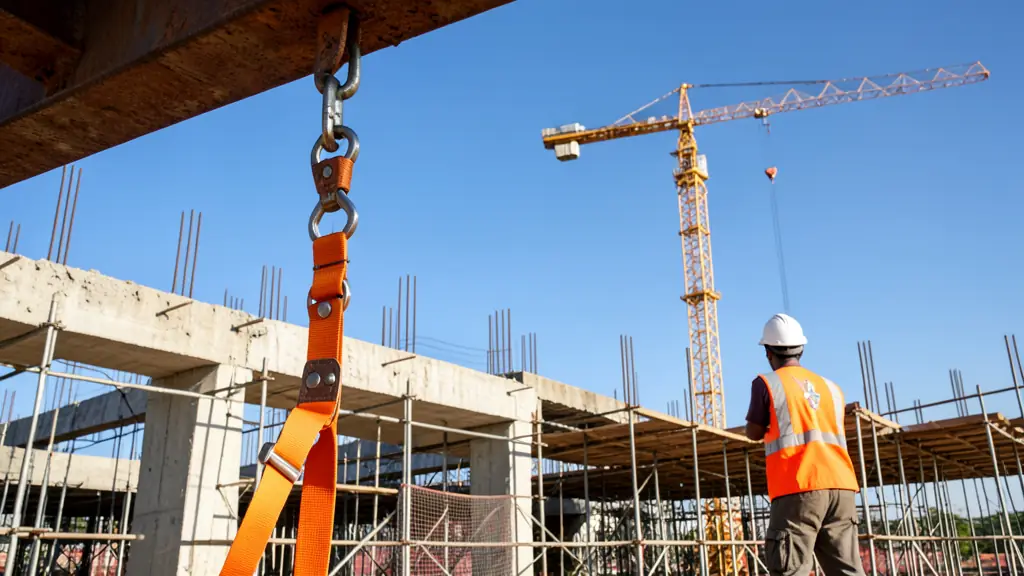
- SANS 50361 or EN 361 full-body harness
- Shock-absorbing lanyards, EN 355
- Self-retracting lifelines, EN 360
- Dorsal, front and side D-rings
- Rescue kits and anchor points
Buying a safety harness means choosing a complete fall arrest system, not just a body belt. The harness, lanyard and anchor must work together. PPESuppliers.co.za is a free quote-request service for South Africa. Tell us what you need and where, and we pass your request to independent PPE suppliers and wholesalers who quote you directly. We do not sell harnesses ourselves. There is no charge and no obligation to accept a quote. Compare offers on the same specification and choose the supplier that can also help with inspection and training.
Full-body harnesses and what they connect to
A full-body harness spreads the force of a fall across the shoulders, chest, hips and thighs. Full-body harnesses follow SANS 50361 or the matching EN standard. A waist belt alone is not suitable for fall arrest.
- Dorsal D-ring: sits between the shoulder blades, for fall arrest.
- Front D-ring: for ladders and rope access positioning.
- Side D-rings: for work positioning, which holds the wearer in place.
- Padded belts and legs: improve comfort on long shifts.
Choose the size and adjustment range to suit each wearer. A loose harness can slip, and a tight one is uncomfortable and gets taken off. Fit it snugly, with straps flat and chest strap closed, before any climb. Ask suppliers about quick-connect buckles for teams that put on harnesses many times a day.
Lanyards, lifelines and anchors
The harness is only one link. A shock-absorbing lanyard limits the force on the body during a fall. Self-retracting lifelines lock when the line is pulled fast, and shorten the fall distance. Adjustable positioning lanyards hold a worker at a pole or wall.
The anchor point must be rated for the load and placed correctly. Calculate the free fall distance and the clearance below. Hooks should lock so they cannot open by accident. Add rescue gear. A worker hanging in a harness can suffer suspension trauma, so a rescue plan and equipment must be ready before work starts.
Hard hats with chin straps and sturdy boots complete the system.
Inspection, training and the law
The Construction Regulations 2014 require a fall protection plan, competent persons and trained workers for work at height. Each wearer should be trained to fit and use the equipment.
- Check straps, stitching, buckles and hooks before every use.
- Tag and remove any harness that has caught a fall.
- Keep a register of formal inspections by a competent person, usually every six or twelve months.
- Follow the manufacturer's maximum life and storage guidance.
Keep harnesses clean and dry, away from sunlight, chemicals and sharp edges. Ask suppliers about inspection services and training courses.
What affects the quote
We do not give prices here. Quotes depend on the harness style, number of D-rings, lanyard type and length, self-retracting lifelines, anchors, carry bags, rescue kits, quantity, training and delivery. Say what the work is, such as roof work, scaffolding, towers or confined spaces, and the heights involved. Tell suppliers the weight range of your wearers, since harnesses and lanyards have limits. Ask for the certificate for each item, and ask whether the supplier offers inspection, repair or re-certification after delivery.
Comparing safety harnesses quotes
PPE prices move with fabric, leather and rubber costs, the exchange rate and stock levels. When quotes arrive, check:
- Exact item and standard: the product, the standard or rating it is certified to, and an NRCS letter of authority where one is required.
- Sizes and quantities: price per unit or per pack, size runs available and any minimum order.
- Stock or lead time: ex stock, or imported or made to order, and how long that takes.
- Delivery and VAT: delivery to site, branding costs, whether VAT is included and how long the price holds.
What to include in your request
- The type of work at height and the heights involved.
- Number of harnesses, lanyards and lifelines needed.
- Wearers' weight range and any need for side D-rings.
- Whether you need anchors, rescue kits or training.
- Your delivery address and the date you need them.
Frequently asked questions
Do you sell safety harnesses?
What is the difference between a harness and a lanyard?
How often must a safety harness be inspected?
Do workers need training to use a harness?
Safety Harnesses by province
- Safety Harnesses Gauteng
- Safety Harnesses Mpumalanga
- Safety Harnesses North West
- Safety Harnesses Limpopo
- Safety Harnesses Northern Cape
- Safety Harnesses Free State
- Safety Harnesses KwaZulu-Natal
- Safety Harnesses Eastern Cape
- Safety Harnesses Western Cape
Safety Harnesses by city and town
- Safety Harnesses in Johannesburg
- Safety Harnesses in Pretoria
- Safety Harnesses in Centurion
- Safety Harnesses in Midrand
- Safety Harnesses in Sandton
- Safety Harnesses in Randburg
- Safety Harnesses in Roodepoort
- Safety Harnesses in Krugersdorp
- Safety Harnesses in Randfontein
- Safety Harnesses in Germiston
- Safety Harnesses in Boksburg
- Safety Harnesses in Benoni
- Safety Harnesses in Kempton Park
- Safety Harnesses in Alberton
- Safety Harnesses in Vanderbijlpark
- Safety Harnesses in Vereeniging
- Safety Harnesses in eMalahleni (Witbank)
- Safety Harnesses in Middelburg
- Safety Harnesses in Secunda
- Safety Harnesses in Mbombela (Nelspruit)
- Safety Harnesses in Rustenburg
- Safety Harnesses in Brits
- Safety Harnesses in Klerksdorp
- Safety Harnesses in Potchefstroom
- Safety Harnesses in Polokwane
- Safety Harnesses in Tzaneen
- Safety Harnesses in Lephalale
- Safety Harnesses in Kimberley
- Safety Harnesses in Kathu
- Safety Harnesses in Upington
- Safety Harnesses in Bloemfontein
- Safety Harnesses in Welkom
- Safety Harnesses in Sasolburg
- Safety Harnesses in Durban
- Safety Harnesses in Pinetown
- Safety Harnesses in Pietermaritzburg
- Safety Harnesses in Richards Bay
- Safety Harnesses in Newcastle
- Safety Harnesses in Ladysmith
- Safety Harnesses in Gqeberha (Port Elizabeth)
- Safety Harnesses in East London
- Safety Harnesses in Kariega (Uitenhage)
- Safety Harnesses in Cape Town
- Safety Harnesses in Bellville
- Safety Harnesses in Paarl
- Safety Harnesses in Stellenbosch
- Safety Harnesses in George
- Safety Harnesses in Worcester