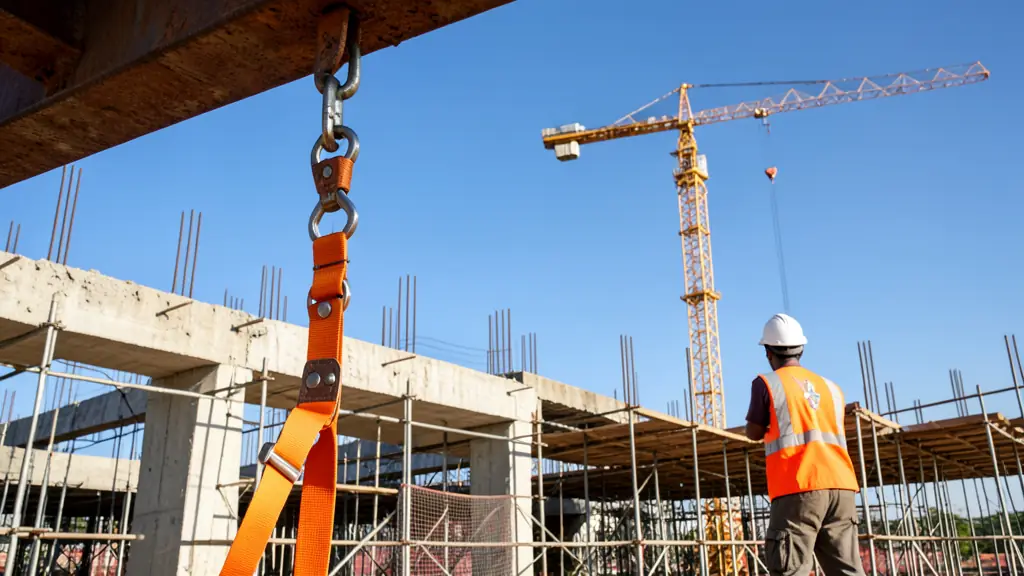
A harness only saves a worker if the fall is stopped before they reach the ground, a lower level or a structure. The calculator adds up the free fall, the energy absorber's extension, harness stretch and a safety margin, and compares the total with the clearance below the work surface.
The parts of a fall
- Free fall: the drop before the lanyard goes taut. With a slack lanyard it is the lanyard length plus the height of the D-ring above the feet, minus the anchor height. Anchor overhead to keep it short.
- Absorber extension: an EN 355 energy absorber tears open to slow the worker and may extend up to 1.75 m.
- Harness stretch and D-ring shift: the harness webbing stretches and the D-ring slides up the back, commonly taken as 0.3 m.
- Safety margin: usually 1 m between the worker's feet and the ground or obstruction at the end of the fall.
With a 1.8 m lanyard anchored at D-ring height, that is 1.8 + 1.75 + 0.3 + 1 = 4.85 m below the work surface. Anchor at foot level and the same lanyard needs about 6.35 m, more than most scaffolds and mezzanines have.
When there isn't enough clearance
- Anchor higher. Every metre of anchor height above the D-ring takes a metre off the free fall.
- Use a self-retracting lifeline. An SRL stays taut and locks within a short distance, often under 1 m in total.
- Use a shorter lanyard, or a twin-leg lanyard to stay tied off while moving.
- Use work restraint instead of fall arrest. A fixed-length lanyard that stops the worker reaching the edge prevents the fall altogether.
The Construction Regulations, 2014 require a fall protection plan by a competent person for work at height, covering the equipment, anchor points, inspection and rescue. Plan the rescue as well: suspension trauma can set in within minutes.
Frequently asked questions
How much clearance does a 2 m lanyard need?
With the anchor at D-ring height (about 1.5 m above the feet), a 2 m energy-absorbing lanyard needs roughly 2 + 1.75 + 0.3 + 1 = 5.05 m below the work surface. Anchored at foot level it needs about 6.55 m.
When is a self-retracting lifeline better than a lanyard?
When clearance is limited, the worker moves vertically (ladders, towers) or across a wide area under an overhead anchor. Check the SRL's label for its arrest distance and whether it is rated for horizontal or leading-edge use.
How often must harnesses be inspected?
The user checks it before every use, and a competent person inspects it in detail at regular intervals, at least every 6 months and more often in harsh conditions. Any harness or lanyard that has arrested a fall is withdrawn from use.
From what height do I need fall protection?
The Construction Regulations require a fall protection plan wherever there is a risk of falling from height; 2 m is the usual threshold used on South African sites and in most company standards, but open edges and holes at any height need protection.
Related PPE
- HZ-07Safety HarnessesSANS 50361 or EN 361 full-body harness
- IN-02Construction PPESANS 1397 hard hats
- IN-04Electrical and Arc Flash PPEIEC 61482 arc-rated clothing
- HZ-01Hard HatsSANS 1397 industrial helmets
More PPE tools
- TL-01PPE Budget CalculatorAnnual PPE cost per employee, per month and per new starter
- TL-02PPE Selector by HazardTick the hazards on the job and get the PPE list with standards
- TL-03Noise Exposure Calculator8-hour noise dose, allowed time and the ear protector SNR you need
- TL-04Respirator Protection Factor CalculatorRequired protection factor, mask class (FFP2, FFP3, full face) and filter colour
- TL-06PPE Size Chart and Size-Run BuilderBoot, glove, overall and vest sizes, plus a size run for your quote
- TL-07EN 388 Glove Rating DecoderRead the 4X43F code on a glove: abrasion, cut, tear, puncture, impact
- TL-08PPE Standards and Replacement GuideSANS and EN standards for each item, and when to replace it