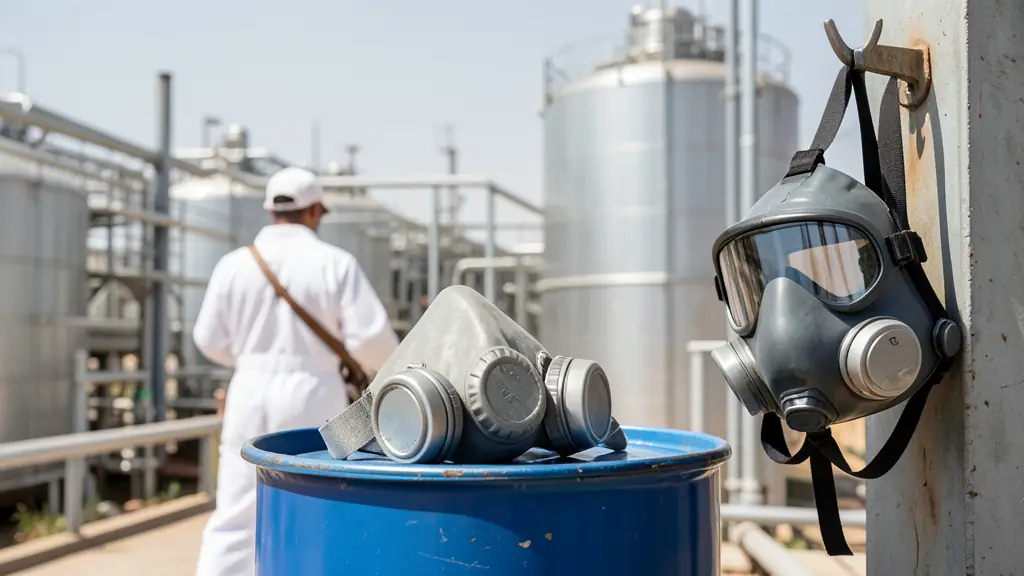
A respirator has to reduce the concentration a worker breathes to below the occupational exposure limit (OEL). The calculator divides the measured concentration by the OEL to get the protection factor you need, then shows which classes of mask and respirator give at least that, and which filter type suits the contaminant.
Protection factor, step by step
Required protection factor = measured concentration ÷ OEL. If welding fume is measured at 25 mg/m³ against a limit of 5 mg/m³, you need a protection factor of 5. An FFP1 (assigned protection factor 4) is not enough; an FFP2 or a half mask with P2 filters (10) is the lowest class that is.
The assigned protection factor (APF) is the level of protection a properly fitted, correctly worn respirator can be expected to give in the workplace. It is lower than the laboratory figure on purpose. Pick a class with an APF at or above the required protection factor, and remember that a tight-fitting mask only gives its APF if it passes a face-fit test on that wearer, who is clean-shaven where the seal sits.
Particles, gases and filter colours
Particle filters (P1, P2, P3, white band) stop dust, mist and fume but do nothing against gases and vapours. Gas filters are colour-coded by what they absorb: A brown for organic vapours such as solvents, B grey for inorganic gases such as chlorine and hydrogen sulphide, E yellow for acid gases such as sulphur dioxide, K green for ammonia. Combined filters such as A2P3 cover spray painting, where there are both solvent vapour and paint droplets. The class number (1, 2 or 3) is the filter's capacity.
Gas filters don't show when they are used up, so set a change-out schedule from the concentration and hours of use, and replace them sooner if the wearer smells or tastes the contaminant.
When filtering respirators can't be used
- Oxygen below 19.5%, or an unknown atmosphere, for example in tanks, sewers and other confined spaces.
- Concentrations that are immediately dangerous to life or health, or above the filter's limits.
- Gases with poor warning properties where no suitable filter exists.
In these cases only supplied-air or self-contained breathing apparatus is suitable, with a standby person and a rescue plan.
Frequently asked questions
What is the difference between FFP2 and FFP3?
Where do I find the occupational exposure limit?
Can a dust mask protect against paint fumes?
Does every worker need a fit test?
Related PPE
- HZ-05Masks and RespiratorsHalf-face and full-face masks, EN 140 and EN 136
- HZ-04Dust MasksSANS 50149 or EN 149 FFP1, FFP2, FFP3
- IN-01Mining PPESANS 1397 hard hats
- IN-03Welding PPELeather welding gauntlets
More PPE tools
- TL-01PPE Budget CalculatorAnnual PPE cost per employee, per month and per new starter
- TL-02PPE Selector by HazardTick the hazards on the job and get the PPE list with standards
- TL-03Noise Exposure Calculator8-hour noise dose, allowed time and the ear protector SNR you need
- TL-05Fall Clearance CalculatorFree fall, total fall distance and the clearance a lanyard or SRL needs
- TL-06PPE Size Chart and Size-Run BuilderBoot, glove, overall and vest sizes, plus a size run for your quote
- TL-07EN 388 Glove Rating DecoderRead the 4X43F code on a glove: abrasion, cut, tear, puncture, impact
- TL-08PPE Standards and Replacement GuideSANS and EN standards for each item, and when to replace it