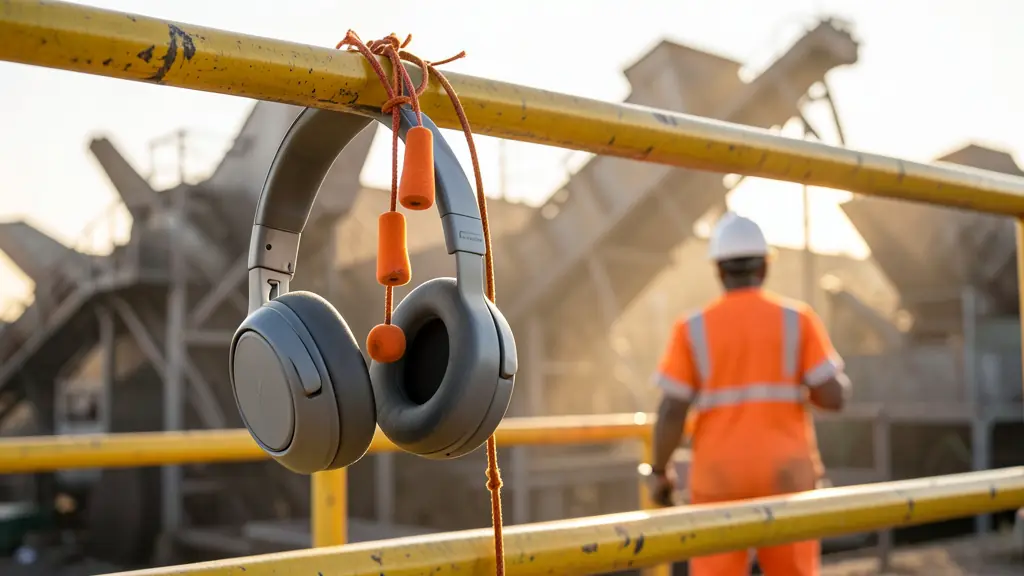
Hearing damage depends on both how loud the noise is and how long a worker is exposed to it. The calculator combines every noise source in a shift into one 8-hour equivalent level, compares it with the 85 dB(A) limit and shows the hearing protector rating that brings the level at the ear into the safe band.
How the 8-hour level is calculated
Decibels are logarithmic, so levels can't simply be averaged. The 8-hour equivalent level is LAeq,8h = 10 × log10( Σ (ti ÷ 8) × 10Li/10 ), where Li is each level in dB(A) and ti the hours at that level. With the 3 dB exchange rate, every 3 dB increase halves the safe time: 8 hours at 85 dB(A), 4 hours at 88, 2 hours at 91, 15 minutes at 100.
The daily dose expresses the same thing as a percentage of the limit: 100% is exactly 85 dB(A) over 8 hours, 200% is twice the allowed energy. Short spells of very loud work, such as angle grinding at 100 dB(A) or more, often make up most of the dose.
Choosing the protector
The SNR (single number rating) printed on earplugs and earmuffs tested to EN 352 is measured in a laboratory. Real-world protection is lower because of fit, so the calculator subtracts 4 dB. The aim is 70 to 80 dB(A) at the ear: enough protection, while workers can still hear speech and warning signals.
- Too little: above 85 dB(A) at the ear, hearing loss continues despite the protector.
- Too much: below about 65 dB(A), workers feel isolated, miss alarms and tend to lift the muff or pull out the plug, which loses most of the protection.
- Wear time matters: taking protection off for even 15 minutes in a 100 dB(A) area undoes much of its benefit.
What the regulations require above 85 dB(A)
Under the Noise-Induced Hearing Loss Regulations (OHS Act), areas where the rating level is 85 dB(A) or more must be demarcated as noise zones, employees exposed must be given hearing protection and be under medical surveillance with audiometry, and the employer must work to reduce the noise. Noise surveys are carried out by approved inspection authorities; use their measured levels in this calculator where you have them.
Frequently asked questions
What is the noise limit in South Africa?
How do I know the noise level without a meter?
Which is better, earplugs or earmuffs?
Why does the calculator subtract 4 dB from the SNR?
Related PPE
- HZ-03Ear Plugs and EarmuffsSANS 50352 or EN 352 tested
- IN-01Mining PPESANS 1397 hard hats
- IN-02Construction PPESANS 1397 hard hats
- IN-03Welding PPELeather welding gauntlets
More PPE tools
- TL-01PPE Budget CalculatorAnnual PPE cost per employee, per month and per new starter
- TL-02PPE Selector by HazardTick the hazards on the job and get the PPE list with standards
- TL-04Respirator Protection Factor CalculatorRequired protection factor, mask class (FFP2, FFP3, full face) and filter colour
- TL-05Fall Clearance CalculatorFree fall, total fall distance and the clearance a lanyard or SRL needs
- TL-06PPE Size Chart and Size-Run BuilderBoot, glove, overall and vest sizes, plus a size run for your quote
- TL-07EN 388 Glove Rating DecoderRead the 4X43F code on a glove: abrasion, cut, tear, puncture, impact
- TL-08PPE Standards and Replacement GuideSANS and EN standards for each item, and when to replace it